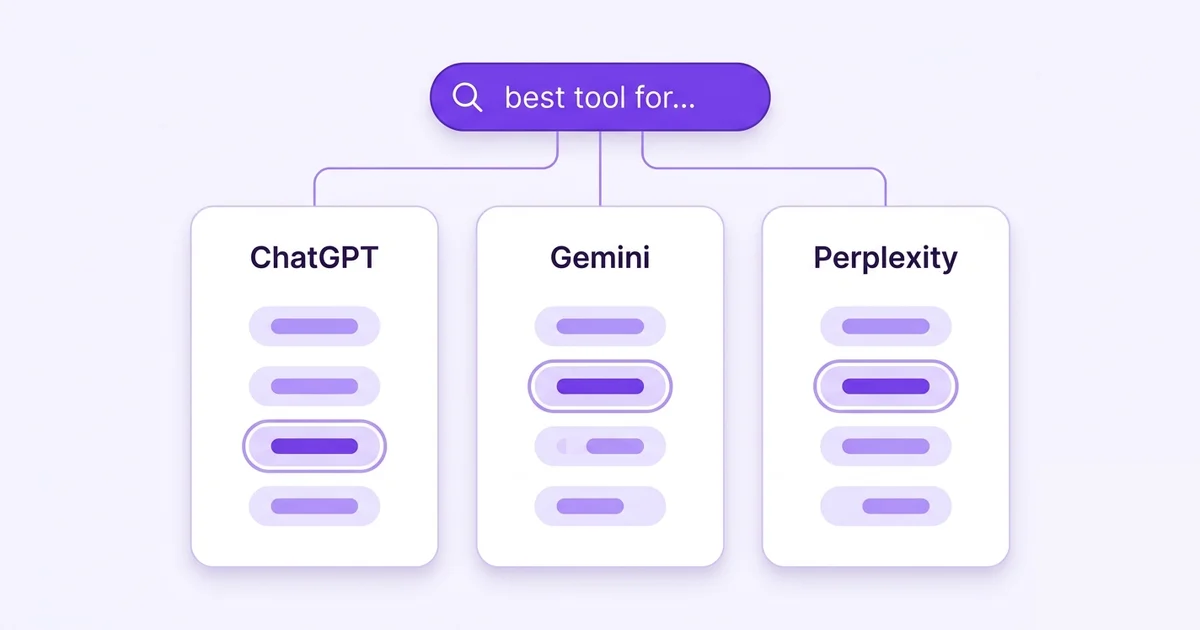
- Across 50 buyer-intent prompts, all three engines named the same brand only 21% of the time. AI visibility is three separate scores, not one.
- 53% of brand mentions came from a single engine. Win one engine and you can still be invisible in the other two.
- HubSpot appeared in 62% of all 150 answers. AI recommendations follow a winner-takes-most curve, not an even spread.
- Each engine has a personality: ChatGPT casts the widest net, Perplexity is the most conservative, Gemini stays Google-flavored.
How much do ChatGPT, Perplexity, and Gemini actually agree?
Barely. Across 50 buyer-intent prompts run through ChatGPT, Perplexity, and Gemini, all three engines named the same brand only 21% of the time.
A buyer-intent prompt is the kind of question someone types right before choosing a tool, like “best CRM for a small team.”
We collected 150 answers and logged 1,257 brand-by-topic appearances. Of those, 53% came from a single engine.
That 21% is the number that should change how you think about AI search. It means AI visibility is not one score you climb.
It is three separate scores, with three different notions of authority, and they barely correlate. A tool can read as the obvious market leader inside ChatGPT and be completely absent from Gemini for the very same question (leadrescue.app analysis, 2026).
What did we ask, and what came back?
We used 50 buyer-intent prompts spread across the software categories founders care about. Each one was a plain question a buyer would type right before picking a tool, not an edge case designed to trip the engines up.
The point was to capture normal recommendation behaviour across common jobs-to-be-done.
The categories we tested included:
- Best CRM for a small business
- Best email marketing tool
- Best SEO tools
- Best project management software
- Best AI tools for productivity
- Best analytics tools for a SaaS product
- Best Slack alternatives for team chat
- Best tools for cold outreach and sales prospecting
- What tools a startup uses to run everything
Here is one raw result, exactly as recorded. We asked all three engines for the best email marketing tools and logged every brand each one named:
| Engine | Brands named for “best email marketing tool” |
|---|---|
| ChatGPT | HubSpot, ChatGPT, Mailchimp, Brevo, Klaviyo, ActiveCampaign, Kit, MailerLite, GetResponse, Shopify |
| Perplexity | HubSpot, Mailchimp, Brevo, Klaviyo, ActiveCampaign, MailerLite, Omnisend, Shopify |
| Gemini | HubSpot, Brevo, Klaviyo, ActiveCampaign, Kit, MailerLite, Shopify |
Look closely and the cracks show even here. All three named HubSpot, Brevo, Klaviyo, ActiveCampaign, MailerLite, and Shopify.
But Mailchimp, one of the biggest names in email, appeared on ChatGPT and Perplexity and was missing from Gemini. Kit was on ChatGPT and Gemini but not Perplexity.
GetResponse showed up only on ChatGPT, Omnisend only on Perplexity, and ChatGPT even named itself. Just 6 of the 11 brands were picked by all three engines, and this was one of the more consistent categories we tested.
Which brands dominate AI recommendations?
A small cluster of incumbents. HubSpot alone appeared in 62% of all 150 answers and showed up across 34 of the 50 topics we tested.
The top 8 brands absorbed most of the mentions, while the remaining 269 names split what was left. AI recommendations follow a winner-takes-most curve, where a few leaders capture far more than an even share.
The reason HubSpot shows up everywhere is not luck. It has enough independent third-party mentions that every engine, whatever its bias, keeps resurfacing it.
That distributed citation footprint is the real GEO target, not gaming one engine. Slack, Mailchimp, Salesforce, and Notion round out the top five.
If you build a small tool, you are not displacing HubSpot from the generic “best CRM” slot. You compete for the niche and comparison queries where the engines are still flexible.
Our guide to AI brand visibility breaks down what that footprint looks like.
Why does each AI engine recommend different tools?
Because each engine has a consistent, repeatable personality. ChatGPT named the most brands per answer, 15.3, and surfaced 59 niche tools that no other engine mentioned once.
Perplexity was the most conservative at 11.9 brands per answer. Gemini stayed mainstream and leaned hard on Google’s own ecosystem, naming Canva 24 times versus ChatGPT’s 10.
Perplexity grounds every answer in live web results, which is why it leans on citation-heavy incumbents and rarely risks an unfamiliar name. That is retrieval-grounding: the engine builds its answer from pages it fetches at query time rather than from memory alone.
ChatGPT blends training data with optional browsing, so it reaches further into the long tail. Structure still decides who gets pulled.
A Princeton-led study found that citations, statistics, and clear formatting lifted a source’s visibility in AI answers by up to 40% (Aggarwal et al., Princeton, 2023).
| Engine | Brands per answer | Distinct brands | Unique to it | Personality |
|---|---|---|---|---|
| ChatGPT | 15.3 | 253 | 59 | Widest net: best for the long tail |
| Perplexity | 11.9 | 172 | 9 | Conservative: incumbent-heavy |
| Gemini | 15.0 | 182 | 3 | Mainstream: Google-flavored |
Can a brand win one engine and lose another?
Yes, and often by a wide margin. Gemini named Canva 24 times; ChatGPT named it only 10.
Gemini recommended Claude, a direct competitor, 13 times, while Perplexity named it once. Salesforce swung from 22 mentions on ChatGPT to 12 on Perplexity.
Microsoft Teams got 10 nods from Gemini and 1 from Perplexity. Same question, three different worlds.
This is the practical cost of the 21% agreement rate. If you measured Canva’s AI visibility on ChatGPT alone, you would call it a mid-tier option.
Measure it on Gemini and it looks like the category default. Neither reading is wrong.
They are answers to different engines. For why one engine trusts a source another ignores, see why Perplexity cites some brands and not others.
What does this mean for your GEO strategy?
Track each engine separately and never trust a blended average. Because the three engines agreed only 21% of the time, a single combined score describes an AI search world no real buyer experiences.
Your buyer uses one engine at a time, so your visibility inside that one engine is what actually counts. GEO, or generative engine optimization, is the practice of getting named inside AI answers, and it is fought per engine.
- Per-engine tracking is the only honest read. A blended score can look healthy while you are absent from the engine your buyers actually use.
- Single-engine optimization is a trap. Model weightings shift often and you control none of them. Optimize to your average and you optimize for no one.
- ChatGPT is the most reachable engine for small tools. It surfaced 59 brands no other engine named, so the long tail lives there. Perplexity and Gemini lean on existing authority and take longer to crack.
- Build a distributed citation footprint. The brands that survive across all three engines, like HubSpot, are cited widely off their own domain, not just on it.
The stakes keep rising as buyers move research into AI. Pew Research found that 34% of US adults had used ChatGPT by mid-2025, roughly double the share two years earlier, with product research among the top uses (Pew Research Center, 2025).
Checking all three engines by hand every week is slow and easy to drop. This is the gap Lead Rescue fills: it runs your prompts across ChatGPT, Gemini, and Perplexity daily and reports your coverage and share of voice per engine, in plain language, so you can see exactly which engine you are missing.
To start measuring it yourself, read how to track brand visibility in AI search.

Lead Rescue tracks each engine on its own, so a strong ChatGPT score never hides a Gemini blind spot. See where AI engines name you →