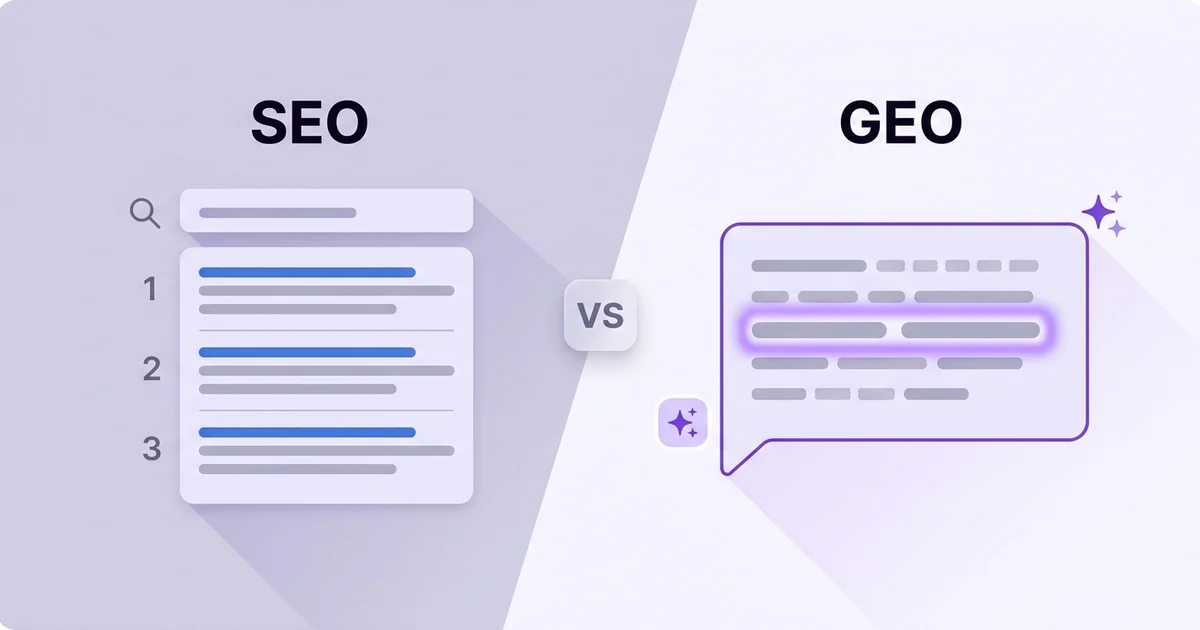
- SEO competes for a ranked link in a list. GEO competes for a named mention inside one AI-written answer.
- SEO is not dead. Gartner projects traditional search volume drops about 25% by 2026, not to zero.
- Most of your SEO groundwork (clear structure, real expertise, citable facts) directly helps GEO too.
- The big gap is measurement: GEO has no ranking position to check, so you track mentions instead.
What's the real difference between GEO and SEO?
SEO and GEO chase the same goal, getting found, but in two different places. SEO (search engine optimization) is the practice of structuring a page so it ranks as a clickable link on a results page. GEO (generative engine optimization) is the practice of structuring content so an AI engine names your brand inside its written answer.
The difference is what you actually win. With SEO you win a position in a list of ten blue links, and the reader chooses whether to click you. With GEO you win a mention or a citation inside a single paragraph ChatGPT writes, and there is no list to climb. You are in the answer or you are invisible. A 2023 Princeton-led study found that adding citations, statistics, and clear structure lifted source visibility in AI answers by up to 40% (Aggarwal et al., Princeton, 2023). For the full breakdown of what GEO is, see our guide to generative engine optimization.
| Dimension | SEO | GEO |
|---|---|---|
| What you win | A ranked link (position 1 to 10) | A mention or citation in one answer |
| Where it happens | A Google results page | A ChatGPT, Gemini, or Perplexity reply |
| Top signals | Backlinks, keywords, page speed | Clear structure, quotable facts, cited sources |
| How you measure | Rank trackers, Search Console | Visibility scans across AI engines |
| Failure looks like | You land on page 2 — still reachable | A competitor gets named, you don't |
Is SEO dead now that AI answers the question directly?
No. SEO is shrinking, not disappearing. Billions of searches still happen on Google every day, and many AI answers are built from pages that earned their authority through classic SEO. The honest framing is that AI search is taking a slice of the pie, not the whole pie. Treating SEO as dead is how brands lose traffic they could still own.
The scale of the shift is real, though. Gartner projects that "traditional search engine volume will drop 25%" by 2026 as buyers move questions to AI chatbots and virtual agents (Gartner, 2024). A 25% drop is enormous, but it still leaves three quarters of search behaviour in place. The smart move is to defend your SEO and build GEO on top, not trade one for the other.
How does AI search change the path your buyer takes?
AI search collapses the buyer's journey from "search, scan, click, read" down to "ask, get an answer." Instead of opening five tabs, your buyer reads one synthesized paragraph that already names a few brands and moves on. The research step that used to send a stream of visitors to your site now often ends before anyone clicks.
The data backs this up. Pew Research Center found that when Google shows an AI summary, users clicked a traditional search result on just 8% of those visits, compared with 15% when no summary appeared, roughly half the click-through (Pew Research Center, 2025). Google AI Overviews is the feature driving this: an AI summary that sits above the normal links. So being the source the summary quotes now matters more than being link number four below it. We dig into whether those citations still send visitors in do AI citations drive traffic.
What carries over from SEO to GEO, and what doesn't?
Most of your SEO foundation transfers directly to GEO. AI engines learn from the same web, and they favour pages that are clear, credible, and well-structured, which is exactly what good SEO already produces. You are not starting over. You are adding a new layer of structure on top of work you have likely already done.
Here is what moves across and what is genuinely new:
- Carries over: clear page structure, real expertise and author signals, fast and crawlable pages, and factual accuracy. Schema.org markup helps both.
- Carries over with a twist: keywords still matter, but as natural question phrasing ("how do I check if ChatGPT mentions my brand") rather than short head terms.
- Genuinely new: writing self-contained, quotable passages an engine can lift whole, and including citable statistics with named sources in the body.
- Falls away: obsessing over exact-match keyword density and chasing a single ranking position. There is no position to chase inside an answer.
Plain English: if your SEO is solid, you are most of the way to GEO. You mainly need to make each section answer one question cleanly, on its own.
How do you measure GEO when there's no ranking to check?
This is the hardest part of the switch. SEO has a clean number: your rank, sitting in Search Console. GEO has no equivalent, because an AI answer is generated fresh each time and varies by user, phrasing, and engine. You cannot open one dashboard and see "position 3." You have to ask the engines the questions your buyers ask and record whether your brand shows up.
In practice that means tracking three things over time: whether you are mentioned, whether you are cited as a source, and your share of voice versus competitors for the same prompts. Doing this by hand across ChatGPT, Gemini, and Perplexity is slow and easy to drop. This is the gap Lead Rescue fills: it runs those prompts automatically every day and tells you, in plain language, whether AI engines name you. To understand the metric itself, start with what AI brand visibility means.