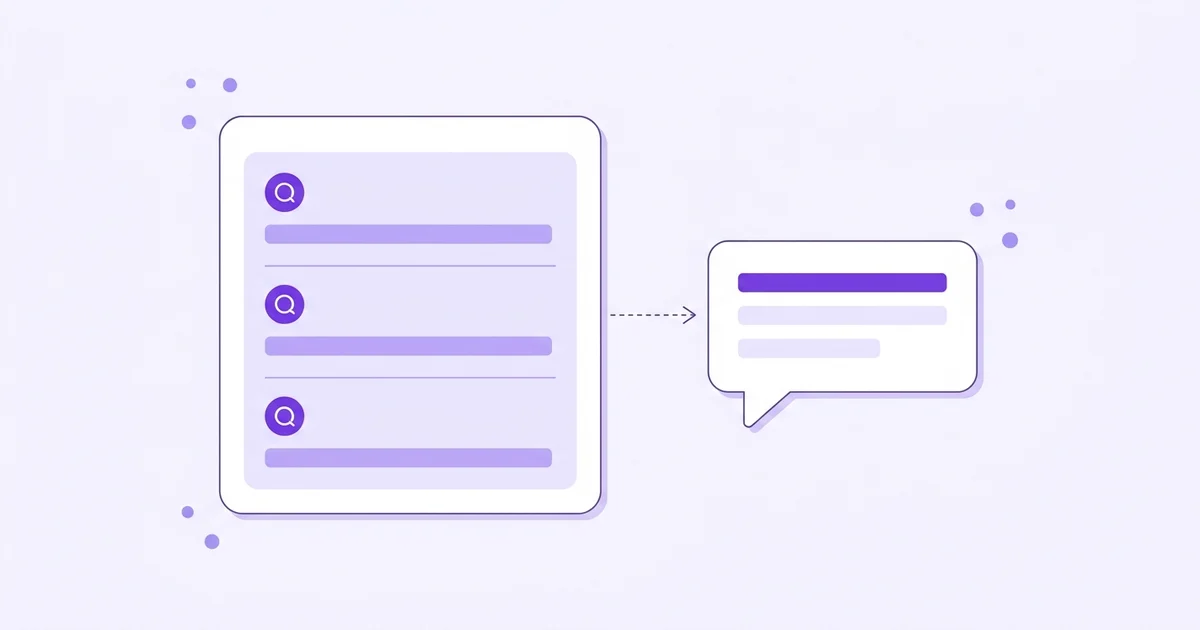
- FAQ schema (FAQPage on schema.org) labels each question-and-answer pair so AI engines extract it precisely rather than guessing at your page structure.
- JSON-LD is the format to use. It sits in your page head and does not require any changes to your visible content.
- Each FAQ answer must stand alone as a complete response. An answer that needs surrounding context will not be extracted cleanly.
- After adding schema, track whether your AI citations actually increased. Schema opens the door; content quality determines whether engines walk through it.
What is FAQ schema and why do AI engines treat it differently?
FAQ schema is structured data markup that explicitly identifies each question and its answer on a page in a format machines can read directly. FAQPage is the formal type on schema.org, a shared vocabulary for structured data maintained by Google, Microsoft, Yahoo, and Yandex. Instead of an AI engine inferring what your page covers from prose, FAQPage markup states it directly: here is a question, here is the complete answer.
A 2023 Princeton-led study on generative engine optimisation found that clearly structured, explicitly labelled content boosted AI source visibility by up to 40% compared to unstructured pages (Aggarwal et al., Princeton, 2023). FAQ schema is the most direct implementation of that structural clarity. A page without schema is content an engine has to parse. The same page with FAQPage markup is a labelled list of extractable answer units.
The difference shows in citations. An unstructured FAQ section might get partially quoted when an engine happens to retrieve the right paragraph. A marked-up FAQ gets extracted at the question level, so each FAQ item is independently citable for a different buyer query.
Which AI engines respond to FAQ schema?
Google's AI Overviews read FAQPage markup directly. Google's developer documentation confirms that eligible FAQ structured data can produce rich results in Search, and those same pages feed the AI Overview answers that appear above the blue links. Perplexity crawls live web content and reads structured data when building answers via PerplexityBot. ChatGPT in browsing mode retrieves structured page content, though OpenAI does not publicly document Schema.org parsing in its documentation.
| Engine | How FAQ schema helps | Confidence |
|---|---|---|
| Google AI Overviews | Direct rich result eligibility; FAQ pairs feed overview summaries | Documented by Google |
| Perplexity | Clean extraction from pages PerplexityBot crawls | Consistent in observed behaviour |
| ChatGPT (browsing) | Better content structure for extraction | Observed; not officially documented |
| Gemini app | Benefits from Google index improvements via FAQPage | Follows Google's indexing approach |
AI Overviews expanded to over 100 countries in 2024 and now appear on a large share of informational queries, so optimising for AI extraction rather than just Google rich results is the right frame. FAQ schema serves both simultaneously.
How do you write FAQ content that actually gets extracted?
Write each FAQ answer as a self-contained response. Someone reading only that answer should get the full picture without needing anything else on the page. If the answer starts with "As I mentioned" or refers back to a previous section, it will not be cleanly extracted. Target 40 to 80 words per answer: long enough to be useful, short enough to be quotable.
Three rules that separate cited FAQ answers from ones that get skipped:
- Answer in the first sentence. "FAQPage schema takes two to three hours to add for a typical site" is extractable. "It really depends on your setup" is not.
- Match the exact query phrasing your buyers use. Run your buyer prompts in ChatGPT and Perplexity, note how each question is phrased in the response, then mirror that wording in your FAQ question text.
- Be specific and factual. Named tools, concrete timeframes, and verifiable outcomes get cited far more than vague general advice. Specificity is what makes a passage worth quoting.
Aim for four to six FAQ items per page. Fewer than four limits the citation surface. More than ten dilutes quality and can trigger thin content signals in Google's quality systems.
How do you add FAQPage markup to your site?
Add FAQPage markup as a JSON-LD script block in the head section of your page. JSON-LD is the format Google recommends and the one most AI crawlers are built to read. It does not touch your visible page content, which means no design changes are required. The structure is a script block with type "application/ld+json" containing an object with "@type": "FAQPage" and a mainEntity array. Each item in that array has a "@type": "Question" with a name (the question text) and an acceptedAnswer object containing the answer text.
After adding it, validate using Google's Rich Results Test, which confirms whether the markup is error-free and eligible for rich results in Search. For a Next.js site, a server component that outputs the JSON-LD in a Script tag with type="application/ld+json" keeps the structured data in sync with the FAQ content in the same file.
How do you know if FAQ schema actually improved your AI citations?
Run your buyer prompts across ChatGPT, Gemini, and Perplexity the week before adding schema and note which pages get cited. Then recheck every two weeks for six weeks. If pages with FAQ schema start appearing as citations where they previously did not, the schema is working. If nothing changes after six weeks, the issue is content quality, not the markup.
Also check Google Search Console for FAQ rich result impressions. A spike within two to three weeks of adding schema confirms Google has read the markup correctly. That same markup feeds AI Overviews, so rich result eligibility is a leading indicator for AI extraction. Lead Rescue shows daily citation patterns across ChatGPT, Gemini, and Perplexity, so you can see whether a page started being cited after a structural change without re-running every prompt by hand.
For the broader content structure that works alongside schema, see our guide on how to write content that gets cited by Perplexity and the full measurement approach in how to track brand visibility in AI search.