- A citation (an engine linking to your page) is a stronger signal than a mention (your brand name appearing). Track both separately.
- ChatGPT, Gemini, and Perplexity give different answers to the same prompt. Visibility in one does not transfer to the others.
- Five metrics cover everything: brand coverage, citation rate, share of voice, average position, and sentiment.
- You can start for free with a spreadsheet and twenty minutes a week. Tools matter once you pass thirty prompts or two sites.
- Fix the lowest broken layer first: missing content beats optimising structure that does not exist yet.
Why do AI citations matter more than search rankings now?
AI citations are links that an AI engine places inside its generated answer pointing to the source it drew from. They matter more than search rankings for one reason: when ChatGPT or Perplexity answers a buyer's question, it names two or three brands in a short paragraph. There is no page two. You are named or you are not.
The audience for those answers is large and growing fast. Pew Research found that 34% of US adults had used ChatGPT by mid-2025, roughly double the share from two years earlier, with product research among the most common uses. Buyers are already asking AI engines "which tool should I use for X?" and acting on the first answer they get.
Traditional SEO measures where your page ranks in a list. AI visibility measures whether your brand gets named at all in a generated response. You can rank on the first page of Google for a keyword and still be invisible to the same buyer when they open Perplexity two minutes later. Both channels matter, and they require separate measurement.
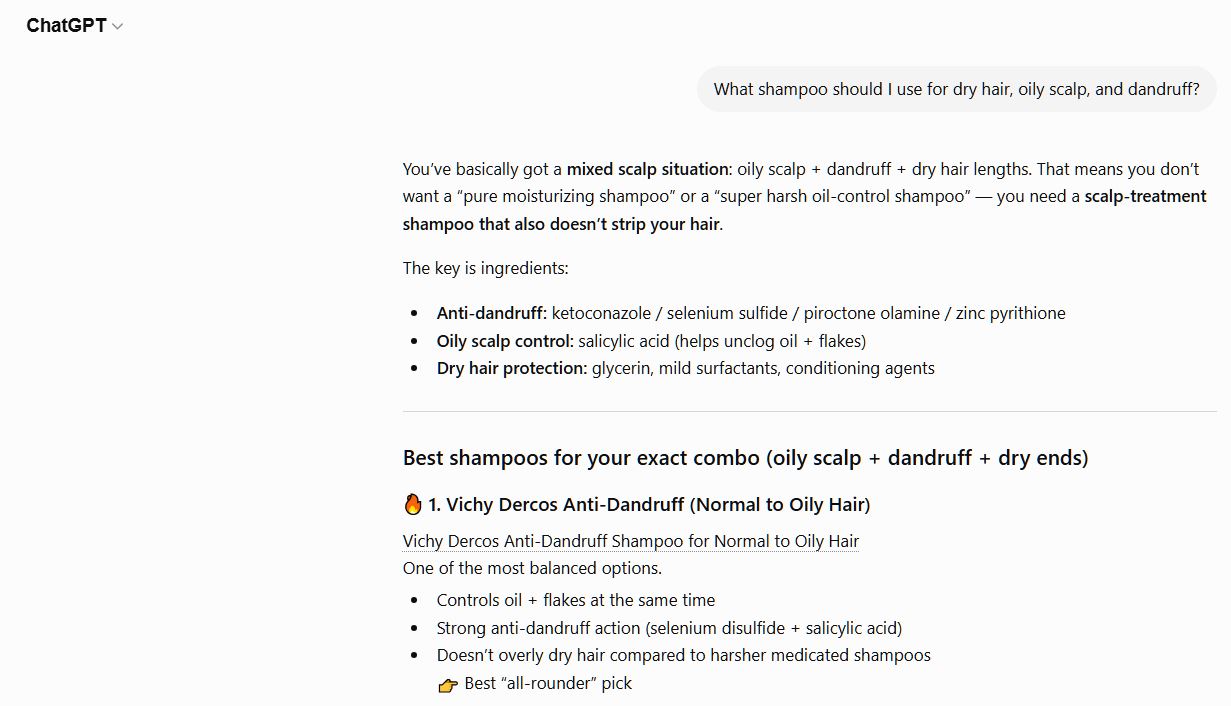
Plain English: A "citation" in AI search means the engine linked to your specific page as a source. A "mention" means it said your brand name somewhere in the answer. Citation is the stronger signal. It means the engine trusted your page enough to send a reader there.
The two layers of AI visibility tracking
Before getting into how to track, it's worth understanding what you're actually tracking — because there are two distinct things at play:
Brand mentions happen when an AI names your company, product, or brand in its response without linking to your site. ChatGPT might write "Tools like Lead Rescue help founders track AI visibility" with no URL attached.
Citations happen when an AI attributes a claim to your content with a link back to your site. Perplexity's numbered source footnotes, ChatGPT's inline hyperlinks, and Google AI Overview's source chips all count as citations.
Both matter — but they tell you different things. A lot of mentions with few citations usually means your brand has awareness but your content isn't structured or authoritative enough for AI engines to use as a primary source. That's a content quality signal, not just a reach signal.
How do AI search engines decide which brands to cite?
AI search engines cite brands that appear across multiple sources they can retrieve, read quickly, and quote cleanly. The process has four steps: the engine fetches pages it can access, filters for freshness and credibility, extracts passages that directly answer the question, and names the brands those passages describe. Your job is to make every one of those steps easy.
Researchers at Princeton and Georgia Tech who defined Generative Engine Optimization found that content with clear structure, inline citations, and concrete statistics earned up to 40% more visibility in AI-generated answers versus unstructured pages (Aggarwal et al., Princeton, 2023).
The mechanism is straightforward. A page that opens with a direct 50-word answer and uses question-shaped headings gives every engine a clean extraction target. A page that buries its answer after four paragraphs of preamble gives the engine nothing quotable to pull.
The surfaces you need to cover are also broader than most people realise:
- ChatGPT blends training data with optional live browsing.
- Gemini powers both the standalone assistant and Google AI Overviews in Search results.
- Perplexity crawls the live web on every query.
- Claude (Anthropic) is increasingly used for research and product discovery.
- Google AI Mode, Google's conversational search interface, pulls from the same index as Gemini but surfaces answers differently.
Each of these can name your brand independently of the others.
Five signals drive most citation decisions:
- Crawlability — your robots.txt must allow AI crawlers (OAI-SearchBot for ChatGPT, PerplexityBot for Perplexity, Googlebot for Gemini and AI Overviews, ClaudeBot for Claude).
- Relevance — the page must answer the exact question asked, not a related one.
- Extractability — answer-first paragraphs, question-shaped headings, and FAQ schema give engines clean sections to quote.
- Third-party corroboration — a brand cited on review platforms, comparison blogs, and forums appears more credible than one found only on its own domain.
- Recency — especially on Perplexity, a clearly-dated recent page outperforms an older one with more backlinks.
What should you actually track for AI visibility?
AI search monitoring covers five distinct data types. Each tells you something different, and missing any one leaves a blind spot the others cannot cover. Here is what each measures and why it belongs in your tracking setup.
Brand Mentions
A brand mention is when an AI engine names your brand anywhere in its generated answer. Mention rate (the percentage of tracked prompts where your brand appears) is the top-of-funnel number.
It tells you whether the engine knows you exist in your category. A high mention rate paired with a low citation rate means the engine knows your name but does not trust your content enough to link to it.
Citations and Citation Frequency
A citation is when the engine links directly to a page on your domain as a source. Citation frequency measures how often those links appear across your full prompt set. Not just whether you were cited once, but whether specific pages are cited repeatedly.
Source URL Analysis takes this further: which of your URLs are being cited, for which prompts, and on which engines. A single well-structured article cited across twelve prompts is more valuable than twelve articles each cited once.
Recommendations
A recommendation is stronger than a mention. It is when the engine actively positions your brand as the preferred choice: "for founders with no SEO background, Brand X is the clearest fit" rather than "Brand X is one option."
Recommendation framing cannot be scored automatically. You have to read the actual answer. Look for superlatives, first-position naming, and direct comparison language that favours you. Recommendations convert buyers. Mentions build awareness.
Share of Voice and Competitor Benchmarking
Share of voice is your brand's percentage of all brand mentions across your tracked prompts, measured against a defined competitor set. Competitor benchmarking is the structured comparison of your share of voice, citation rate, and average position against each named competitor over time. If your share of voice is 18% and your nearest competitor's is 54%, the gap is your strategy: find every prompt they win that you lose, and close it one page at a time.
AI Visibility Score and KPIs
An AI Visibility Score is a composite metric that rolls brand coverage, citation rate, average position, and sentiment into a single index. It lets you compare your position across time periods or against competitors without juggling five separate numbers.
Most dedicated tools compute one automatically. If you are tracking manually, you can approximate it: (mention rate × 0.3) + (citation rate × 0.4) + (position score × 0.2) + (sentiment score × 0.1). The exact formula matters less than sticking to the same one every cycle.
| KPI | What it measures | Healthy trend |
|---|---|---|
| Brand mention rate | % of tracked prompts where your brand is mentioned | Rising; higher than closest competitor |
| Citation rate | % of prompts where an engine links to your pages | Growing alongside mention rate, not lagging |
| Citation frequency | How often specific pages are cited across your full prompt set | Key pages cited across multiple prompts and engines |
| Share of voice | Your mentions as % of all brand mentions across tracked prompts | Growing share within your competitor set |
| Average position | How early your brand appears in the answer when mentioned | Positions 1 to 3 carry the recommendation weight |
| Sentiment | Whether the engine frames you positively or negatively | Net positive; no recurring negative claims |
| AI Visibility Score | Composite index across all five signals above | Rising week-on-week; ahead of key competitors |
Competitor benchmarking runs alongside all of these. If a rival appears in 80% of your tracked prompts and you appear in 20%, the gap is your content priority list.
Prompt-by-prompt source URL analysis shows exactly which pages they are winning through. That citation list is a free gap analysis the engine hands you every time you run a scan.
How can you measure AI visibility for free?
You can start tracking AI visibility with tools you already have, before spending anything. The free layer combines existing analytics platforms with direct manual prompt checks. Past thirty prompts or two sites, a dedicated tool earns its cost. But the free layer is where everyone should start.
What can your existing tools tell you?
Three tools you probably already have give you a useful starting point. Here is what each one shows and how to set it up.
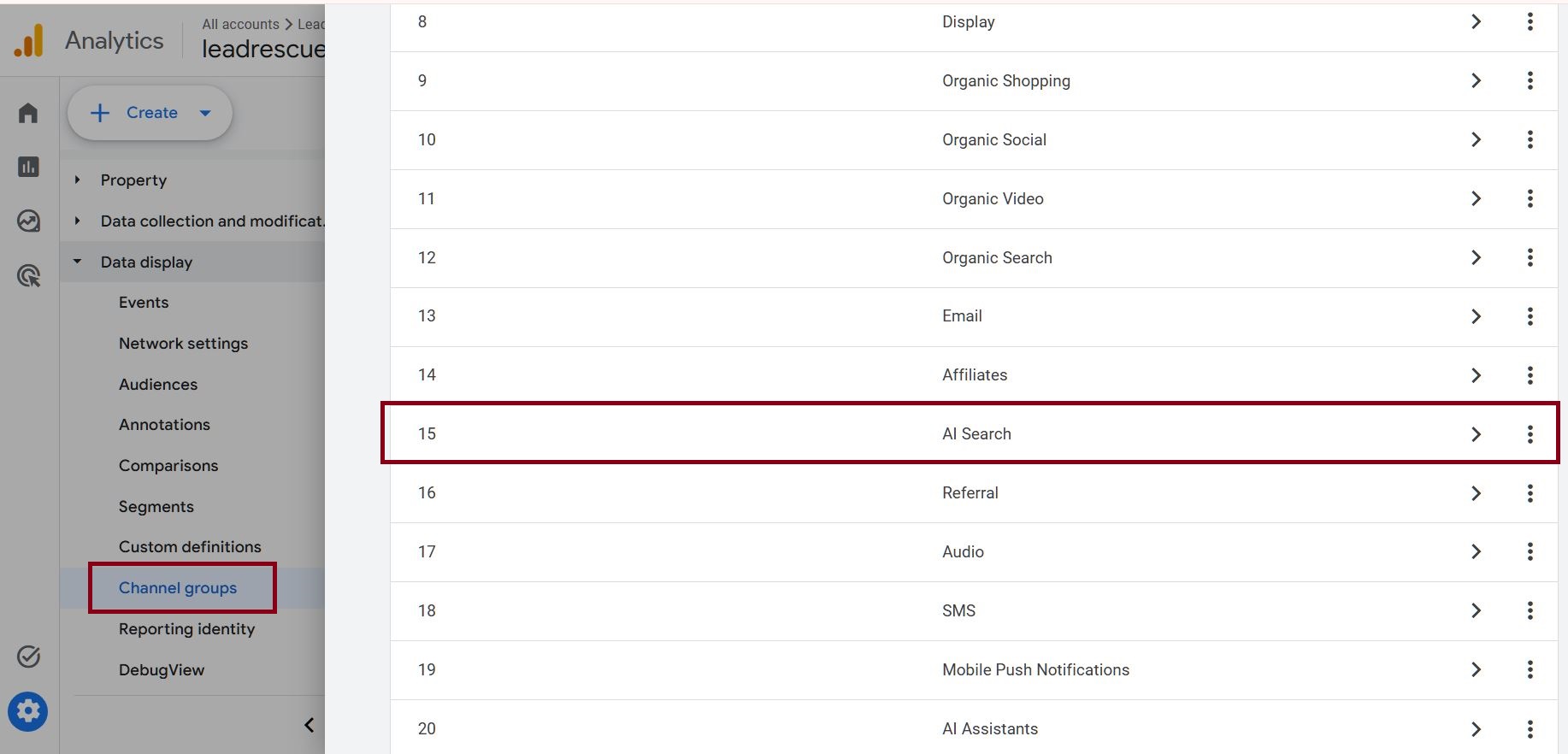
1. Google Analytics 4 lets you track AI referral traffic, but you need to create a custom channel first. Here is the exact setup:
- Go to Admin → Data display → Channel groups
- Click Create new channel group and name it AI Search
- Add a new channel inside it, also named AI Search
- Set the condition: Session source / matches regex / paste this value exactly:
chatgpt.com|perplexity.ai|gemini.google.com|claude.ai - Save. The channel now appears in your Traffic acquisition report.
Sessions from those four domains count as AI-driven visits, giving you a concrete read on how often AI citations send real buyers to your site.
One limit: GA4 only captures clicked visits. It shows nothing about answers where your brand appeared but no link was included.
2. Google Search Console shows which queries triggered a Google AI Overview impression in Google Search. It says nothing about ChatGPT or Perplexity. Still worth a weekly check because Gemini and AI Overviews draw from the same index. If you rank for a query but do not appear in AI Overviews, your page structure is the first place to investigate.
3. Bing Webmaster Tools is underused but valuable if Copilot matters to your audience. Microsoft Copilot runs on Bing's index, so pages Bing has not crawled cannot appear in Copilot answers. The tool shows your indexed pages, flags crawl errors, and supports IndexNow for fast URL submission. Check the AI Performance tab — currently in beta — to see which queries and pages are surfacing in Copilot answers. If you are invisible in Copilot, start your diagnosis here.

What requires manual prompt checks?
- Build a prompt library. Write 15 to 25 questions your buyers would type into an AI engine just before choosing a product like yours. Cover "best [category] for [use case]," "how do I [problem]," and "[your category] vs [alternative]" questions. Save this as your prompt library: the fixed set you rerun identically every cycle so results are comparable over time.
- Run them across three engines separately. Open ChatGPT, Gemini, and Perplexity in separate tabs and paste each prompt. Start a fresh conversation for each one. Previous answers in a session can influence results. Perplexity shows 5 to 8 source citations per answer inline, making it easy to see exactly which pages earned citations for your topic.
- Log the results with the date. For each prompt and engine, record: brand mentioned (yes/no), position in the answer, page cited (yes/no and which URL), sentiment, and which competitor appeared when you did not.
- Rerun every two weeks. One check is a snapshot. Six to eight checks over three months give you a trend. Mark every content action you take with a date so you can connect changes in visibility to specific work.
For a full walkthrough of the first manual check, read how to check if ChatGPT mentions your brand.
Which tools track AI search citations and sources?
Dedicated AI visibility tools automate prompt scanning, store results over time, and compute the metrics a spreadsheet cannot calculate at scale. Most cover ChatGPT, Gemini, and Perplexity. The real difference between tools is whether they do anything useful with the results beyond displaying them.
| Tool | Platforms tracked | Key strength | Price | Best for |
|---|---|---|---|---|
| Lead Rescue | ChatGPT, Gemini, Perplexity | Daily prompt monitoring, citation source tracking, competitive benchmarking, full AI visibility metrics coverage, and actionable recommendations | $29/month (5-day free trial) | Indie SaaS founders, budget-conscious SMB businesses |
| Profound | ChatGPT, Perplexity, Copilot, AI Overviews | Page-level citation tracking and AI traffic attribution | Enterprise pricing | Enterprise marketing teams |
| Otterly.ai | ChatGPT, Google AI, Perplexity, Claude | Link citation analysis, prompt monitoring, competitive benchmarking | From $29/month | Agencies and consultants |
| Peec AI | ChatGPT, Gemini, Perplexity | Share of voice tracking and competitor visibility across engines | From $49/month | Growth marketers |
| Manual spreadsheet | Any | Zero cost, works for any engine, full control over what you track | Free | Beginners, single site |
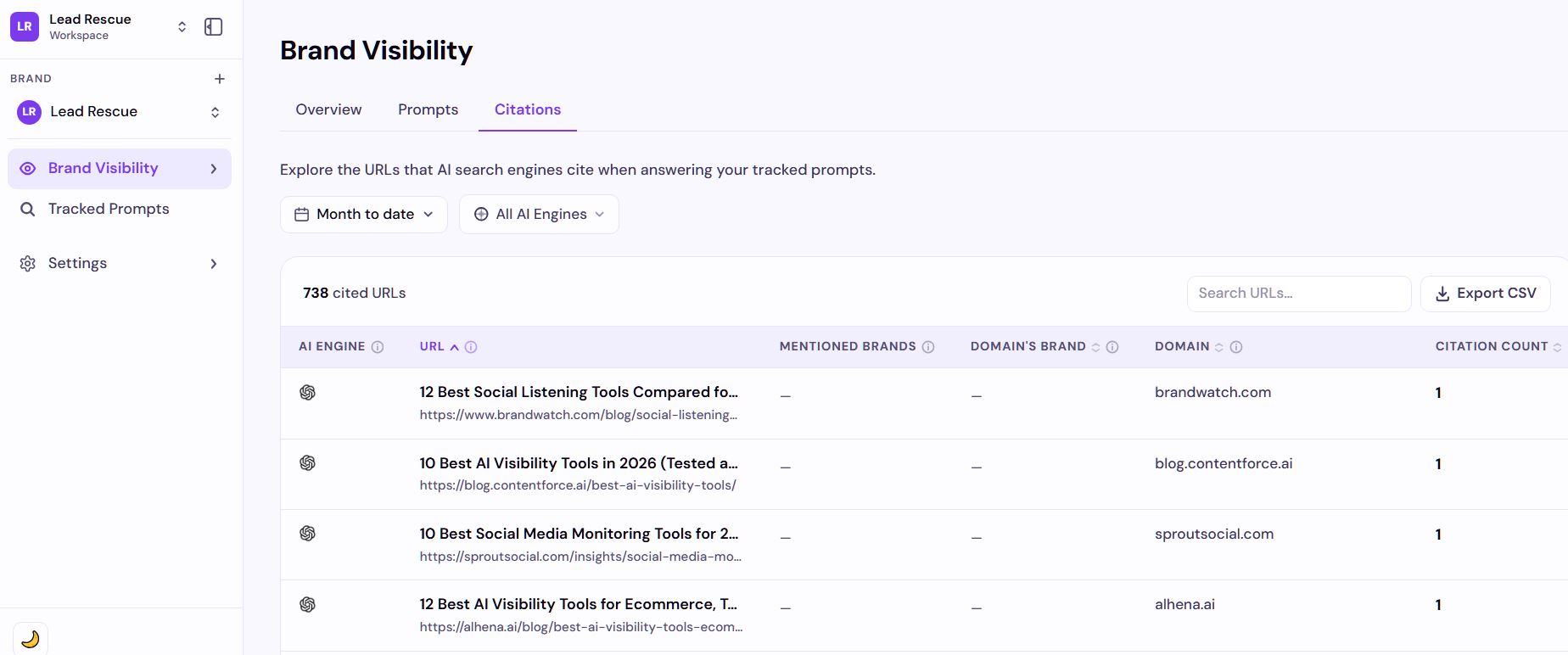
Quick win: run your top 20 prompts manually before choosing any tool. Reading real AI answers directly is often where the clearest insights come from, and it makes the tool data more useful when you do start automating.
For a prompt-by-prompt breakdown of how to analyse competitor citations, read how to track which competitors AI engines recommend.
How do you build a GEO reporting framework and improve results?
A GEO reporting framework (also called an AI search analytics system) ties your tracked metrics to specific actions and each action to a measurable outcome.
AI search monitoring is the data collection layer underneath it: running your prompt library on schedule, storing results, and computing your KPIs. The reporting framework sits on top of that. It is the dashboard, the change log, and the cadence that tells you what to do next and whether the last thing you did actually worked.
What does a useful AI visibility dashboard look like?
A practical dashboard has three layers:
- Top layer: four headline numbers at a glance: brand coverage, citation rate, share of voice against your top two competitors, and average position.
- Middle layer: a prompt-by-prompt table with columns for mention (yes/no), citation (yes/no), position, and which competitor appeared when you did not.
- Bottom layer: a trend chart that connects metric changes to the content actions you logged, so you can see what actually moved the needle.
Keep a change log next to the chart. Every article you publish, every directory you join, every schema addition you make — log it with a date. AI answers typically shift two to six weeks after a well-indexed page goes live. Without those dated entries, you cannot connect an improvement to its cause.
How do you improve your AI recommendations once you see the gaps?
Fix the lowest broken layer first. The order matters because a structural problem is irrelevant if the page does not exist yet, and structure is irrelevant if crawlers cannot reach the page.
- If you are absent from a prompt entirely: publish a page that directly answers it. Do not optimise structure that does not exist yet.
- If you are mentioned but not cited: your content exists but is not set up for extraction. Add an answer-first opening, question-shaped H2 headings, and an FAQ block. The Princeton GEO research confirmed structure improvements alone can shift AI visibility by up to 40% (Aggarwal et al., 2023), without changing your domain authority at all.
- If a competitor is consistently cited and you are not: find out which sources are citing them. Get your brand listed in those same places.
What are the most common mistakes in AI citation tracking?
- Checking only one engine. ChatGPT and Perplexity cite different sources and return different brand recommendations for the same prompt. Treating a ChatGPT result as your full AI visibility picture is like checking one city's weather to plan a national tour.
- Measuring without acting. A dashboard showing you are absent for twelve prompts is useful only if you then publish twelve pages. The data is a prompt, not a destination.
- Expecting instant feedback. AI engines typically take two to six weeks to surface a newly published, well-structured page. Log your content actions with dates, then check back on a schedule rather than refreshing daily.
For a full breakdown of the metrics to watch and how to interpret them over time, read how to track brand visibility in AI search.
Lead Rescue runs daily automated scans of your tracked prompts across all three engines, so the trend data builds itself while you focus on publishing. Start tracking your AI citations →