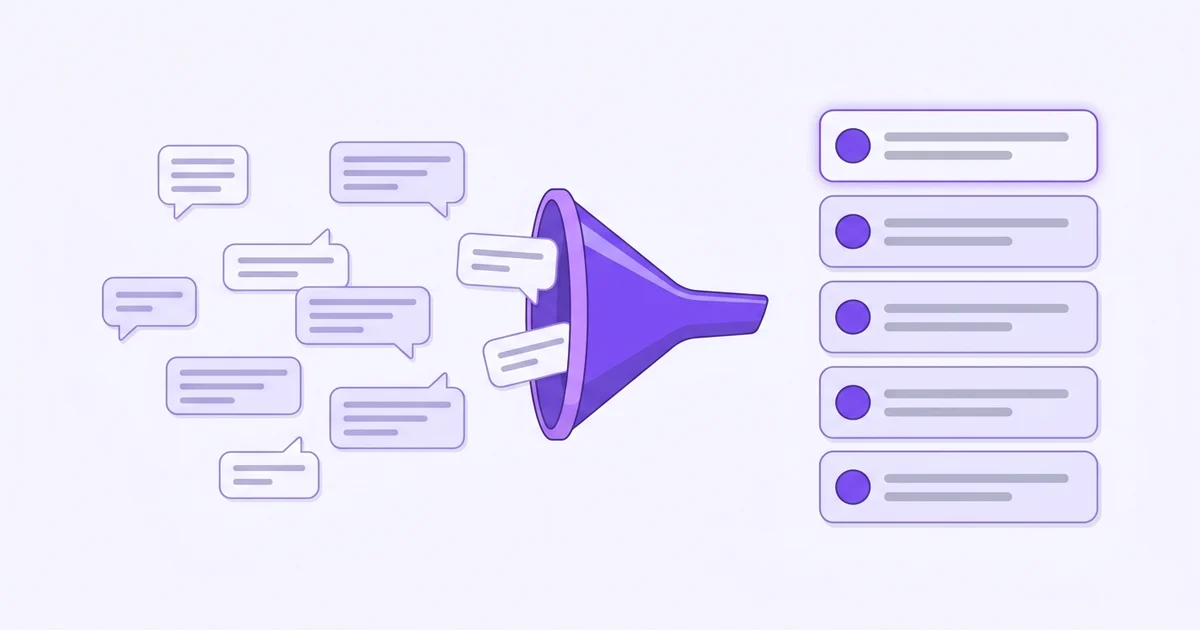
- Prompt research finds the full questions buyers type into AI assistants. Keyword tools miss most of them.
- The best wording comes from sales calls, support tickets, Reddit threads, and long Search Console queries.
- Score each prompt on buying intent, product fit, and winnability, then keep the top 15 to 25.
- Test every prompt several times on each engine before you lock the list.
What is prompt research, and how is it different from keyword research?
Prompt research is the process of finding, scoring, and testing the exact questions your buyers ask AI assistants like ChatGPT, Gemini, and Perplexity, so you know which answers your brand needs to appear in. Keyword research finds the short phrases people type into Google and sizes them by search volume.
When Semrush matched ChatGPT prompts against its keyword database, it found that 65% to 85% of them could not be matched to any traditional search keyword (Semrush, 2026). The data comes from a clickstream panel, so read it as a strong direction rather than an exact count.
| Keyword research | Prompt research | |
|---|---|---|
| What you collect | Short phrases typed into Google | Full questions asked to an AI assistant |
| Typical length | A few words | 8.7 words with web search on, 13.5 without (Semrush, 2026) |
| Volume data | Yes, from keyword tools | None public — use proxies |
| What the searcher wants | A page to read | A decision made for them |
Here is the short version we use with founders: keywords tell you what people want to find, and prompts tell you what they want decided.
A buyer asking which invoicing tool a two-person agency should use wants a shortlist, not ten links.
Where do you find the questions buyers actually ask AI?
The best prompts come from places where buyers already write or say their questions in their own words. That means sales and demo calls, support tickets, Reddit and community threads, long queries in Google Search Console, and the related questions AI engines suggest under each answer.
- Sales and demo calls. The first question a prospect asks is often the exact question they asked ChatGPT the night before. Search your call recordings or transcripts for “what’s the best” and “is there a tool”.
- Support tickets. New users’ questions show the problem they were solving when they found you.
- Reddit and niche communities. Buyers ask for recommendations in public, with their constraints spelled out. In our study of 7,409 AI citations, Perplexity leaned on Reddit and forum threads more than ChatGPT or Gemini did.
- Google Search Console. Filter for queries of seven words or more, or ones starting with how, what, which, or best.
- Related questions in Perplexity. Run a seed question and note the follow-ups Perplexity suggests underneath.
Aim for 60 to 100 raw questions before you start cutting.
How do you turn raw questions into prompts worth tracking?
Rewrite each raw question as the full sentence a buyer would type into ChatGPT, with the context they would add, and without your brand name in it. A good tracked prompt names a category, a situation, and often a constraint like team size or budget, so the engine has to choose brands to answer it.
A tracked prompt is a fixed question you ask AI engines on a schedule, worded identically every time.
- Write it as a full question. “crm small team” becomes “What’s the best CRM for a five-person sales team?” That is how people talk to an assistant.
- Add the buyer’s context. Search-enabled ChatGPT prompts nearly doubled in length, from 4.7 to 8.7 words, between early 2025 and early 2026 (Semrush, 2026). The extra words are constraints like budget, tech stack, or team size, so include them.
- Leave your brand out. A prompt with your name in it will always mention you, which tells you nothing. Track brand-name prompts on a separate list.
- Cover all four prompt shapes. Mix best-of, comparison, problem-first, and feature prompts, as described in our guide to tracking brand visibility in AI search.
- Merge near-duplicates. If two prompts would get the same answer, keep the one closer to real buyer wording.
How do you decide which prompts matter most?
Score each candidate on three things: how close the asker is to buying, how well your product fits the answer, and whether a smaller brand can realistically get named. Multiply the three scores and keep the top 15 to 25.
We call this the Prompt Priority Score, and it replaces search volume when volume data does not exist.
The Prompt Priority Score is a 1 to 27 rating: intent, fit, and winnability, each scored 1 to 3, multiplied together.
| Factor | 1 point | 2 points | 3 points |
|---|---|---|---|
| Buying intent | Learning (“what is a CRM?”) | Comparing (“HubSpot vs Pipedrive”) | Choosing (“best CRM for a 5-person team under $50”) |
| Product fit | Adjacent problem | Partial match | Exactly what you sell |
| Winnability | Category giants fill every answer | Mixed answers | Narrow niche, few brands named |
Winnability matters more than most founders expect. In our 50-prompt study, HubSpot appeared in 62% of all 150 answers, and in a separate 261-answer study Nike was named in 94% of answers about sneakers.
Broad prompts are winner-takes-most, so a small SaaS usually earns its first mentions on narrow ones.
Here is how three prompts score for a made-up invoicing tool aimed at small agencies:
| Prompt | Intent | Fit | Winnability | Score |
|---|---|---|---|---|
| “What is an invoice?” | 1 | 1 | 1 | 1 — drop |
| “FreshBooks vs Wave for freelancers” | 2 | 3 | 2 | 12 — keep |
| “Best invoicing tool for a two-person agency that bills in USD and EUR” | 3 | 3 | 3 | 27 — top priority |
Note: the Prompt Priority Score is a judgment tool, not a measurement. Two founders can score the same prompt differently, so write one line of reasoning next to each score and revisit it after your first month of tracking.
Quick win: multiplying means one weak factor sinks the whole prompt. Anything scoring 12 or more goes on your list, and anything under 6 is not worth tracking yet.
How do you test a prompt before you commit to tracking it?
Run each shortlisted prompt at least three times on ChatGPT, Gemini, and Perplexity before you add it to your list. Keep it only if the answers name brands, the brands named are your real competitors, and the results are stable enough to compare week to week.
One run is a snapshot, not a signal.
A prompt panel is the fixed set of prompts you run on every engine, every time you check.
Repeat runs matter because answers move. When we ran the same 5 questions daily for 13 days, 47.5% of cited sources changed from one day to the next.
Engines also disagree with each other. Across 50 buyer-intent prompts, ChatGPT, Gemini, and Perplexity named the same brand only 21% of the time, so a prompt that works on one engine can be empty on another.
Query fan-out is when an AI engine quietly splits one prompt into several related searches before it answers. Google’s own documentation says “Both AI Overviews and AI Mode may use a "query fan-out" technique” to answer (Google Search Central, 2025).
Our free Query Fan-Out Generator shows the hidden sub-questions an engine would likely run behind each prompt.
Watch out: drop any prompt whose answer names no brands at all, such as a definition question. It can never show you a mention.
How often should you refresh your prompt list?
Review your prompt list every quarter, but change as little as you can. Keep a fixed core of prompts unchanged so your trend lines stay comparable, and swap out only the few that stopped naming brands or no longer match how buyers talk.
Log every change with its date.
Buyer language does shift. Semrush found that the share of ChatGPT prompts using traditional search language nearly doubled from October 2025 to February 2026 (Semrush, 2026).
The habit itself is spreading too. OpenAI’s own usage study, published by the National Bureau of Economic Research (NBER), found that “Seeking Information” grew from 14% to 24% of ChatGPT conversations between May 2024 and June 2025, and the authors wrote that it “appears to be a very close substitute for web search” (NBER, 2025).
Our rule of thumb is to change no more than one prompt in five per quarter.
Is there search volume data for AI prompts?
Not in the way there is for Google keywords. OpenAI, Google, and Perplexity do not publish how often a given prompt is asked, and Semrush could not match 65% to 85% of ChatGPT prompts to any keyword in its 2026 analysis.
Better proxies are how often a question comes up on sales calls, Reddit upvotes, and Search Console impressions for long, question-shaped queries.
What tools can you use for prompt research?
The research itself needs only free tools. Google Search Console keeps 16 months of query data, and Reddit search and Perplexity’s related questions show how buyers phrase things.
Once your list is set, Lead Rescue can run it for you. You add your own prompts, and it scans them daily across ChatGPT, Gemini, and Perplexity, then shows in plain English which ones name you and which name competitors.
Is prompt research the same as prompt engineering?
No. Prompt engineering is writing better instructions so an AI model gives you better output, while prompt research is studying what your buyers ask AI.
With “Seeking Information” now 24% of ChatGPT conversations (NBER, 2025), prompt research is a marketing task, not a technical one.
Want to know where you stand on the prompts that matter? Lead Rescue scans your tracked prompts daily on ChatGPT, Gemini, and Perplexity and shows, in plain English, which ones name you and which name competitors. Check your AI visibility →