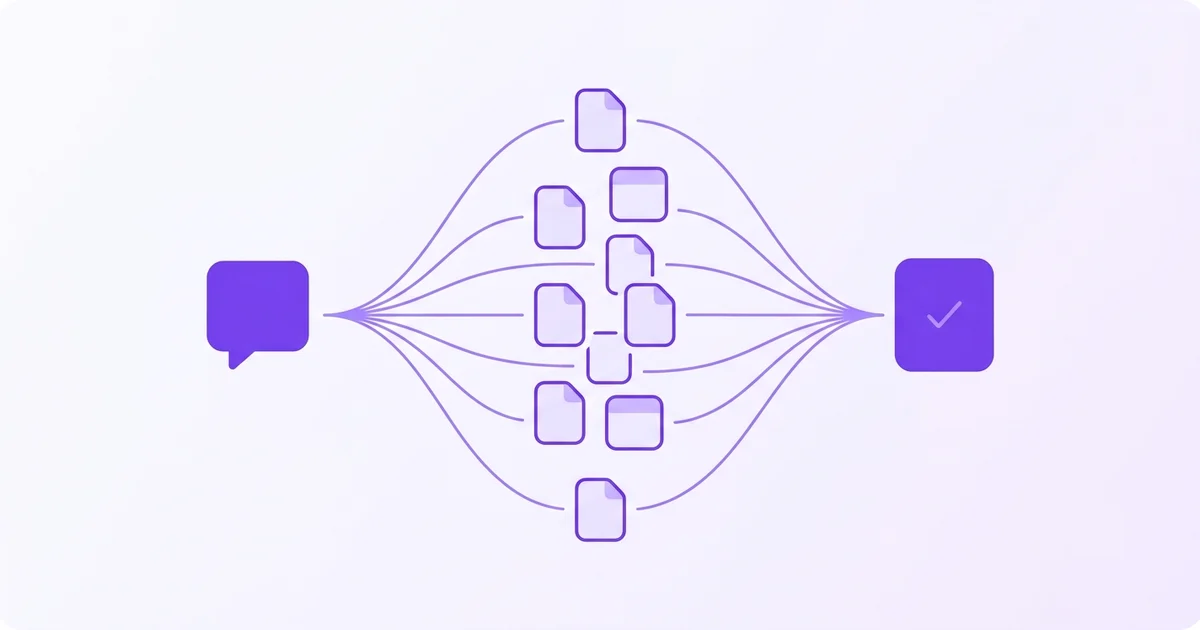
- One question becomes many. AI engines split your query into subtopics and search each one separately.
- Google confirmed the technique publicly in May 2025 when it launched AI Mode.
- Ranking first for your main keyword does not mean you win the hidden sub-searches.
- Coverage wins. Pages that answer the follow-on questions get named more often than pages that answer only one.
What is query fan-out, exactly?
Query fan-out is a search technique where an AI engine turns your single question into a set of related searches, runs them in parallel, and merges the results into one written answer. The searches happen behind the scenes.
You see the answer. You never see the searches that produced it.
Google named the technique itself. When it launched AI Mode in May 2025, the company wrote that "AI Mode uses our query fan-out technique, breaking down your question into subtopics and issuing a multitude of queries simultaneously on your behalf" (Google, 2025).
The scale is larger than most people assume. In the same announcement Google said its Deep Search mode "can issue hundreds of searches" for a single request before it writes anything.
Structuring content to survive this is the whole point of generative engine optimization, or GEO.
How is this different from query expansion?
Query expansion is the older idea: the engine adds synonyms and variants to one search so it catches more matching pages. Fan-out goes further.
Instead of widening one search, the engine breaks your question into separate sub-questions and retrieves sources for each. One search becomes many searches, not one bigger search.
Take the question "best noise-cancelling headphones." Here is what each approach actually runs:
| Query expansion | Query fan-out |
|---|---|
| best noise-cancelling headphones | best noise-cancelling headphones for travel |
| top ANC headphones | Sony vs Bose noise cancelling comparison |
| best noise cancelling earbuds | cheapest noise-cancelling headphones under $100 |
| Still one search, wider net | noise-cancelling headphone battery life reviews |
Expansion returns one list of matches. Fan-out runs all four as separate searches, then blends what each found into a single answer.
How does query fan-out actually work?
Fan-out runs in five stages. The engine reads your intent, writes its own sub-questions, retrieves sources for each, pulls out the specific passages it wants, then blends those into one answer.
Each stage narrows the pool of pages that can end up cited. Your page has to survive all five.
- Read the intent. The engine works out what you actually want, including things you never said. "Best CRM for startups" implies a small team, a tight budget, and fast setup.
- Write the hidden queries. It generates its own sub-searches around those subtopics. You never type them and you never see them.
- Retrieve for each one. Every sub-query pulls its own sources, and different sub-queries can be routed to different places: the open web for reviews, a shopping feed for prices, a knowledge graph for plain facts.
- Keep only the useful passages. The engine does not hold on to whole pages. It scores individual chunks of text and keeps the sections that answer one specific sub-query.
- Blend into one answer. The surviving passages are stitched into a single reply that cites a handful of the pages they came from.
Stage two is where most brands lose. A sub-query is a search the engine writes for itself, derived from your question but never shown to you.
These are not random. Search Engine Land catalogues eight distinct types, including follow-up, generalization, specification, and clarification queries (Search Engine Land, 2025).
Step one has a name: latent intent, the need you clearly have but never typed. Nobody asking for a startup CRM types "free tier", but the engine checks anyway.
Step four is the one that should change how you write. iPullRank's AI Search Manual puts it bluntly: the system is "ranking not entire pages but atomic units of information" (iPullRank, 2025).
So a page can be cited for one strong section while the rest is ignored. For a single example query, that manual counts 15 to 20 sub-queries in the expansion stage alone.
Note: "fan-out" is industry shorthand, not an official term. Google's own patent language for the underlying method is "query variant generation" (patent US11663201B2).
What are the six types of fan-out sub-query?
Fan-out sub-queries are not random rewrites. Each one has a job: reformulation rephrases your question, specification narrows it, comparison pulls in rivals, follow-up predicts what you would ask next, generalization adds background, and validation checks reviews and pricing.
Learning the six types is what turns "the engine searched some other things" into a list of headings you can actually write.
| Sub-query type | What the engine is doing | Example for "best CRM for startups" |
|---|---|---|
| Reformulation | Asks the same thing in different words, to catch pages that phrase it another way | top CRM software for early-stage companies |
| Specification | Adds a constraint you implied but never typed, like budget, team size, or use case | CRM for a 5-person sales team under $50 a month |
| Comparison | Runs head-to-head and "alternatives to" searches that pull in competitor round-ups | HubSpot vs Pipedrive for startups |
| Follow-up | Searches the question you would ask next, before you have asked it | how long does CRM setup take |
| Generalization | Zooms out for background that gives the specific answer context | what does a CRM actually do |
| Validation | Sanity-checks the answer against reviews, pricing pages, and credibility signals | Pipedrive reviews 2026 pricing |
The mix matters more than the count. A question with an obvious comparison branch, like anything with "best" in it, fans out heavily into comparison and validation searches, which is exactly where a brand's own product page has nothing to offer.
What do the six types look like on a real question?
Here is our free Query Fan-Out Generator run on "best running shoes for flat-footed beginners." One typed question, 12 modelled sub-queries, spread across the six types.
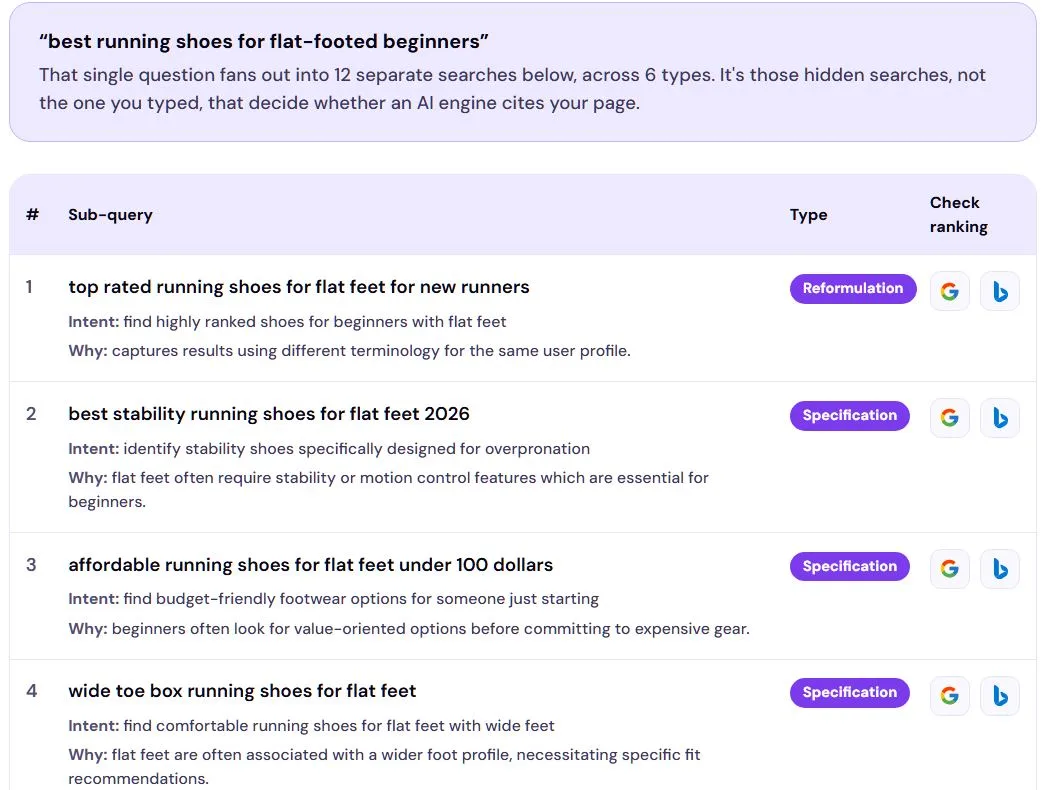
Read the "Why" line on each row and the gap becomes obvious. Nothing in that list is answered by a product page that only says which shoes are best. Flat feet, overpronation, a $100 ceiling, and a wide toe box are four separate branches, and each one is a heading somebody else is winning.
You can run your own question through the Query Fan-Out Generator free. It models the sub-queries a modern engine would plausibly write and groups them by type. It cannot capture the real searches, because no engine publishes them, so treat the output as a coverage checklist rather than a log of engine activity.
Who should use the Query Fan-Out Generator?
Anyone deciding what a page should cover before writing it. Founders working on their own category, content marketers turning one question into a full outline, and agencies explaining to a client why ranking first is no longer the whole job.
- Before you write. Turn the sub-queries into your H2s so one page covers several branches instead of one.
- When auditing a page that ranks but never gets cited. The list shows which follow-up questions your content quietly leaves unanswered.
- When planning a topic cluster. The branches tell you which supporting pages are genuinely worth writing and which would just be thin duplicates.
- In a client conversation. Twelve labelled searches behind one question make the invisible half of AI search concrete in a way a keyword list never does.
What does query fan-out look like in a real search?
Take "best running shoes for beginners." The engine does not run that one search.
It runs separate searches for cushioning, price, common beginner mistakes, brand comparisons, and recent reviews, then blends the lot into one answer. The page that gets cited is usually the one that covered several of those angles at once.
We watched this happen. In our own tracking of 150 AI answers about running shoes across ChatGPT, Gemini, and Perplexity, Nike was named in 93% of answers, yet nike.com was cited as a source exactly once.
The domains that did get cited were review and comparison sites: YouTube 188 times, RunRepeat 115 times, Reddit 39 times. No brand's own website appeared in the top 20.
That is fan-out doing its job. Sub-queries like "beginner running shoe reviews" and "Nike vs On cushioning" do not land on a product page, they land on the page that compared things.
The full experiment, including which sources each engine leaned on, is in our study of where AI search engines get their brand information.
The same pattern holds in SaaS. Your pricing page answers one sub-query about cost, while a good comparison post answers three or four at once.
How is this different from a normal Google search?
A traditional search matches your exact words against an index and hands back a ranked list. Fan-out does the opposite: it decides what your question really contains, searches for each part, and returns a written answer with a few sources attached.
One gives you options. The other gives you a conclusion.
| Dimension | Traditional search | Query fan-out |
|---|---|---|
| Searches run | One, the one you typed | Many, written by the engine |
| What comes back | A ranked list of links | One written answer plus a few sources |
| How you win | Rank high for one keyword | Answer several related questions well |
| What you can see | Your query and the results | The answer only: sub-queries stay hidden |
| Failure looks like | You slip to page two | You are absent from the answer entirely |
The consequence shows up in click data. Pew Research Center found users clicked a traditional search result on 8% of visits where an AI summary appeared, against 15% where none did (Pew Research Center, 2025).
Ranking first still matters. It just stopped being the finish line, because the answer sitting above your link was assembled from searches you never competed in.
Our breakdown of what actually differs between GEO and SEO covers the wider shift.
Which AI engines use query fan-out?
Google AI Mode, Gemini, ChatGPT, Perplexity, and Microsoft Copilot all expand a single question into multiple retrievals. Google is the only one that has publicly named the method.
Treat the rest as observed behaviour rather than documented fact, because each engine describes its retrieval differently and changes it often.
| Engine | What is publicly documented | What that means for you |
|---|---|---|
| Google AI Mode | Named "query fan-out" by Google, May 2025 | The confirmed case: assume subtopic splitting |
| Google Deep Search | Google says it "can issue hundreds of searches" | Research-style prompts scan extremely widely |
| Gemini | Grounded in Google Search | Behaves closest to AI Mode in practice |
| ChatGPT | Runs live web search inside answers | Observed searching several angles per question |
| Perplexity | Shows its search steps in the interface | The easiest place to watch fan-out happen |
How does Google AI Mode use query fan-out?
AI Mode is Google's fullest implementation: type a question and the interface can literally display "Searching 8 queries" while it runs several hidden searches behind the scenes before writing anything.
Google upgraded the technique in November 2025 alongside Gemini 3, saying "now, not only can it perform even more searches to uncover relevant web content, but because Gemini more intelligently understands your intent it can find new content that it may have previously missed" (Google, November 2025).
Fan-out also runs on images. Upload a photo and AI Mode splits it into separate searches for the whole scene plus each object inside it: "AI Mode then issues multiple queries about the image as a whole and the objects within the image" (Google, April 2025).
AI Overviews uses the same underlying technique for shorter, simpler questions, while AI Mode is built for the "more complex, longer and multimodal questions" people are increasingly typing.
How does ChatGPT Search use query fan-out?
ChatGPT breaks your prompt into several sub-queries and runs them against Bing, and it usually adds words you never typed.
An analysis of ChatGPT's fan-out patterns found it frequently injects commercial and temporal modifiers: "best" shows up in roughly 24.3% of fanouts for advice-style questions, and the current year gets appended to about 5.44% of prompts (Rudzki, Peec AI, 2026).
A modifier here is a word bolted onto your question that you never wrote. "Which Samsung Galaxy should I get?" becomes "best Samsung Galaxy phones comparison 2026" behind the scenes.
Content already phrased with that comparison and review language lines up with what ChatGPT was going to search for anyway.
How does Perplexity use query fan-out?
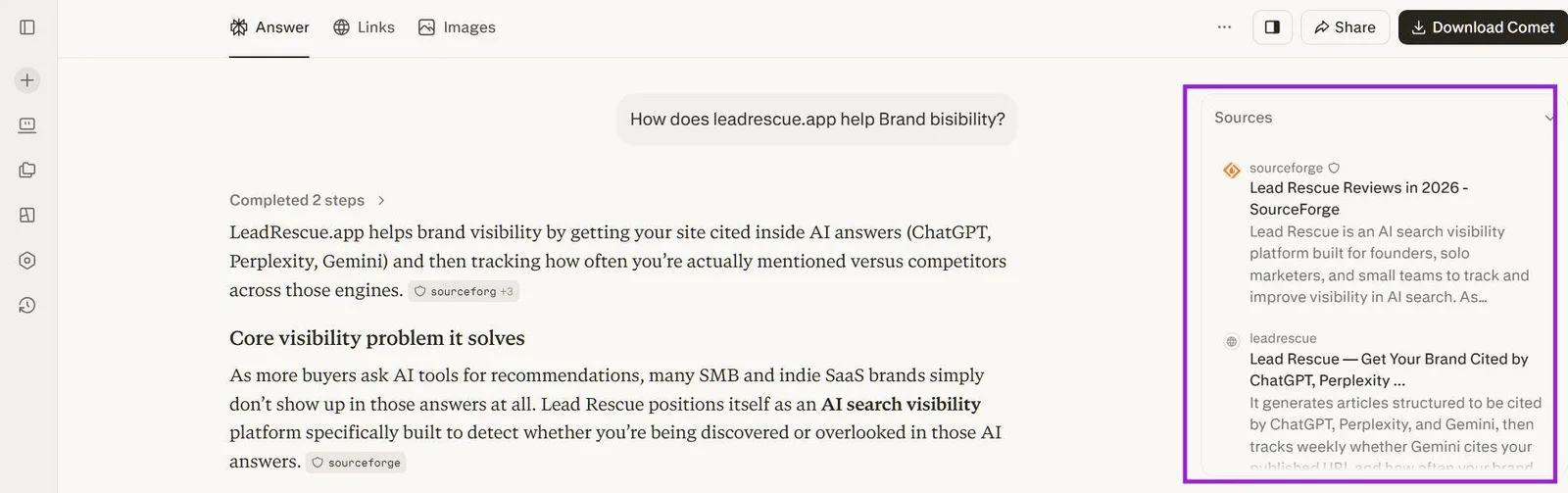
Perplexity is the most transparent of the three: it shows its search steps as it works and cites every source inline with a visible source panel, so you can watch fan-out happen in real time.
It is also the steadiest in our own tracking. Running the same prompts daily for 13 days, Perplexity's citations changed from one day to the next only 28.9% of the time, against 60.7% for ChatGPT and 54.9% for Gemini, full detail in our study of whether AI citations change day to day.
Visible sourcing plus that stability makes Perplexity the easiest engine to audit by hand: ask your question, read which sources it names, and you can tell almost immediately whether your content satisfied one of its sub-queries.
If every engine wrote the same sub-queries, they would name the same brands. They do not.
Across 50 buyer-intent prompts (150 answers, 277 distinct brands), over half of all brand mentions came from a single engine. The full breakdown is in our study of whether AI engines recommend the same brands.
How do you optimize content for query fan-out?
You optimize for fan-out by covering a topic from several angles instead of one, structuring each section so it can be lifted out and cited alone, and writing the follow-up content a reader would want next. Ranking for the one query you targeted is not enough when the answer is assembled from several searches you never see.
We call the distance between those two things the fan-out gap: the one question you optimised for versus the several hidden ones that actually decided the answer. Closing it is most of the work.
Which topics should you build fan-out visibility around?
Start with the topics where you already have genuine authority and where an AI mention would actually drive business, not every keyword you can rank for.
Then run a gap analysis: a comparison of which buyer prompts already surface your brand against which ones surface competitors instead. Ask the same questions your buyers ask, across ChatGPT, Gemini, and Perplexity, and log who gets named.
That comparison, not a keyword list, tells you where the content effort actually pays off.
How do you build topic clusters that cover the fan-out tree?
A topic cluster is a pillar page giving the broad overview plus several supporting pages that each go deep on one subtopic, all interlinked. The more branches of the fan-out tree your cluster covers, the more sub-queries you can win.
Take the CRM example from earlier. A pricing page alone answers "cheapest CRM for small teams." Add a real comparison page and you also answer "HubSpot vs Pipedrive." Add a setup guide and you pick up "easiest CRM to set up" too.
One thin page chasing one keyword only ever wins one branch. This is the same hub-and-spoke logic search engines have rewarded for years, just applied to sub-queries instead of keywords.
How do you write for the follow-up questions readers ask next?
Engines do not stop at decomposing your literal question. They also predict the latent intent behind it and go looking for the follow-up, whether you wrote it down or not.
Someone asking about a training plan will likely also want to know about gear. Someone asking about project management software will likely also want pricing, integrations, and team-size limits.
Map those natural next questions and answer them on the same page, under their own headings, instead of making the reader (or the engine) go hunting for a second article.
How do you make each section citable on its own?
Because engines extract specific chunks rather than whole pages, a section has to make sense lifted completely out of context. Our guide to writing content Perplexity cites goes deeper on this.
Descriptive headings phrased as real questions, short paragraphs, and open comparisons ("X vs Y", "alternatives to X") all make a section easier to extract cleanly.
The payoff is measurable. A 2023 study by Aggarwal and colleagues at Princeton and Georgia Tech found that citations, statistics, and clear structure lifted source visibility in AI answers by up to 40% (Aggarwal et al., 2023).
Quick win: open your best-performing article and add three H2s answering the questions a reader would ask right after finishing it. That is three more sub-queries you can win.
The catch is that you cannot see the sub-queries directly. The only honest test is the output: ask the engines the questions your buyers ask, then record whether you get named.
Lead Rescue runs those prompts across ChatGPT, Gemini, and Perplexity every day and reports which URLs each engine cited. That is how you tell a closed fan-out gap from an open one.
Is query fan-out just keyword research with a new name?
No. Keyword research finds terms real people type into a search box, and you choose which ones to target. Fan-out queries are written by the engine, typed by nobody, and never shown to you. You cannot pull them from a keyword tool. The overlap is real, but you are optimising for machine-written questions, not human search volume.
Do AI engines generate the same fan-out queries every time?
No. Sub-queries shift with phrasing, engine, and even the day. Running the same prompts over 13 days, we found 47.5% of citations changed from one day to the next, and only 4.3% of cited sources showed up on 12 or more days. Treat any single AI answer as one sample, not a ranking.
Can you see the hidden queries an AI engine runs?
Partly. Perplexity shows its search steps in the interface, so you can watch several sub-searches run for one question. Google AI Mode does not expose its fan-out queries, and ChatGPT only shows fragments. The practical workaround is to ask your own question, then write down every follow-up you would naturally ask next.
Our free Query Fan-Out Generator does that step for you: type one question and it models the sub-queries an engine would run, grouped by what each search is doing.
Does ranking first on Google guarantee a mention in the AI answer?
No. Ranking first wins the query you targeted, but the answer is assembled from several sub-queries you did not compete in. A page ranked lower that covers more of those angles can be cited instead. This is why brands with strong Google rankings still find themselves missing from AI answers entirely.