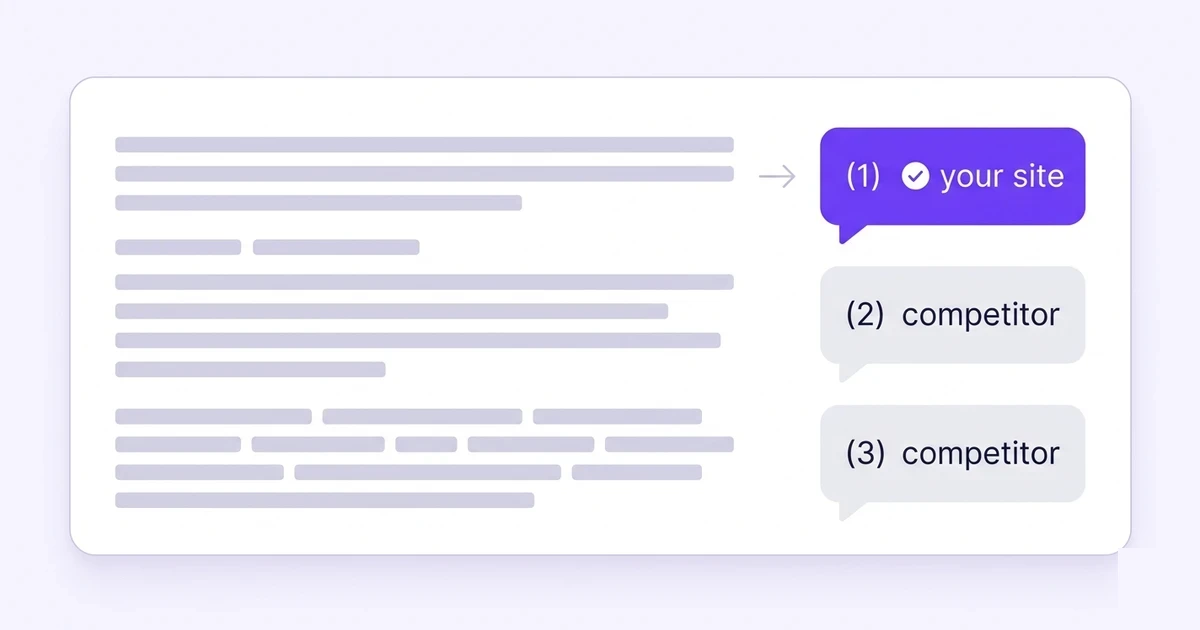
- Perplexity retrieves live web pages for every query. Your content must exist on pages Perplexity actually indexes.
- Content that directly answers a question in the first 100 words gets extracted and cited far more reliably than buried paragraphs.
- Third-party mentions on G2, Capterra, Reddit, and recognised tech publications carry more weight than your own site alone.
- Recency matters. Perplexity weights fresh content, so recently published or updated pages have an advantage.
- Being cited in Perplexity is a function of source coverage and answer clarity, not advertising or relationships with Perplexity.
How does Perplexity actually choose which sources to cite?
Perplexity runs a web search for every query using a search index (Perplexity has acknowledged using Bing's index, as documented in their developer documentation and press coverage), retrieves a set of candidate pages, and then uses its language model to synthesise an answer from those pages. The sources it cites are the pages it retrieved and drew from.
If your brand appears prominently and clearly on those pages, your brand gets cited.
This is fundamentally different from how ChatGPT or Gemini handle brand mentions in their base models. Those models surface brands from training data, which has a cutoff.
Perplexity's retrieval happens at query time. A page you published yesterday can appear in a Perplexity answer today if it is indexed and directly answers the question.
According to Perplexity's Sonar API documentation, which developers can access publicly at docs.perplexity.ai, queries are processed by combining web retrieval with language model generation. The practical implication: standard SEO fundamentals that help pages get indexed also help them appear as Perplexity citations.
What content formats does Perplexity cite most reliably?
Pages that open with a direct answer to the question in the first paragraph get cited more often than pages that bury the answer after several paragraphs of context. Perplexity retrieves the parts of a page most relevant to the query and needs to find that relevance quickly.
Numbered lists and step-by-step content get extracted cleanly. If a page answers a how-to question with a numbered five-step process, Perplexity can lift those steps directly into its answer with the citation attached.
Wikipedia, G2, Capterra, Product Hunt, and Reddit appear frequently as Perplexity citations for software-related queries. These platforms are heavily indexed, updated regularly, and carry community-validated content.
Appearing on these platforms is not optional if you want Perplexity coverage. Adobe Analytics found that traffic to US retail sites from generative AI sources grew 1,200% between July 2024 and February 2025, so the buyers using these engines are a growing audience.
Getting listed on the comparison sites Perplexity already cites is the fastest route to a citation for a new brand.
Why does Perplexity cite my competitor and not me?
The most common reason is that your competitor has more relevant pages indexed, across more trusted sources, that directly answer the prompts your buyers are running. Perplexity's retrieval pulls from whatever the web says.
If the web says more about your competitor than about you, Perplexity reflects that.
A second reason is content structure. If your competitor's pages open with clear, direct answers and yours open with introductory paragraphs or marketing copy, their content is easier to extract even if yours technically covers the same ground.
A third reason is third-party source coverage. Perplexity cites external sources heavily.
A competitor who has been reviewed on G2, mentioned in TechCrunch, discussed in relevant Reddit threads, and listed on Product Hunt has five to ten citation-ready sources. A brand with only its own website has one.
| Why they get cited | What your competitor has | What to do about it |
|---|---|---|
| Source coverage | More relevant pages indexed across more trusted sources | Publish pages that answer your buyers' questions and make sure they are indexed |
| Content structure | Pages that open with a clear, direct answer | Put the answer in the first 100 words of every key page |
| Third-party coverage | Reviews on G2, press mentions, Reddit threads, a Product Hunt listing: five to ten citation-ready sources | Get listed and reviewed on those platforms and earn at least one press mention |
The same root causes that make ChatGPT recommend your competitor apply to Perplexity.
How do I make my brand more likely to appear in Perplexity answers?
- Publish content that directly answers the questions your buyers ask Perplexity. Find five to ten questions your buyers would type into Perplexity and publish a page that answers each one clearly in the first paragraph. The page title should match the question.
- Put the answer first, every time. Perplexity retrieves the most answer-dense portion of a page. If your answer is in paragraph three, it may not be retrieved. Rewrite your key pages so the core answer appears in the first 100 words.
- Get listed and reviewed on the platforms Perplexity trusts. Claim and fully complete your G2, Capterra, and Product Hunt profiles. These platforms are indexed heavily and appear in Perplexity results for software comparison queries.
- Get mentioned on Reddit in relevant communities. Perplexity cites Reddit frequently for experience and opinion queries. Participate authentically in communities where your buyers ask questions. A genuine mention of your product in a helpful comment can become a Perplexity citation.
- Earn at least one piece of press coverage with your brand name in it. A single article from a recognised tech publication creates a trusted, high-authority citation source. Perplexity weights these heavily. Our full guide on writing content Perplexity cites covers all the structural details.
- Update your pages regularly. Perplexity weights recency. A page last updated two years ago loses to a page updated last month on the same topic. Add a visible "Last updated" date to key pages and refresh the content when anything changes.
Does my website's domain authority affect Perplexity citations?
Yes, but not as the only factor. Based on observable Perplexity citation patterns, higher-authority domains appear more often as sources for competitive queries.
TechCrunch, Wikipedia, and G2 consistently appear because they are trusted, heavily indexed, and answer questions clearly. However, Perplexity also cites smaller, newer sites when those sites are the clearest available answer to a specific question.
A small SaaS company's help doc or blog post can appear in Perplexity answers if it directly addresses a niche query that no larger site has answered well.
Domain authority matters for broad competitive queries, but niche long-tail queries are winnable even for new sites. Start with the specific, underserved questions in your category, not the broad category-level terms where established brands already dominate.
How quickly does Perplexity pick up new content?
Faster than ChatGPT or Gemini. Because Perplexity searches the live web at query time, new content can appear in Perplexity answers within days of being published, provided the page is indexed by Bing.
Most new pages get indexed by Bing within two to five days of being crawled. This is one of Perplexity's most important properties for content strategy.
You do not need to wait for a model update cycle to see results. Publish a well-structured answer to a question, get it indexed, and Perplexity can start citing it within a week.
ChatGPT and Gemini may take months to surface the same content in their training-data-driven responses.