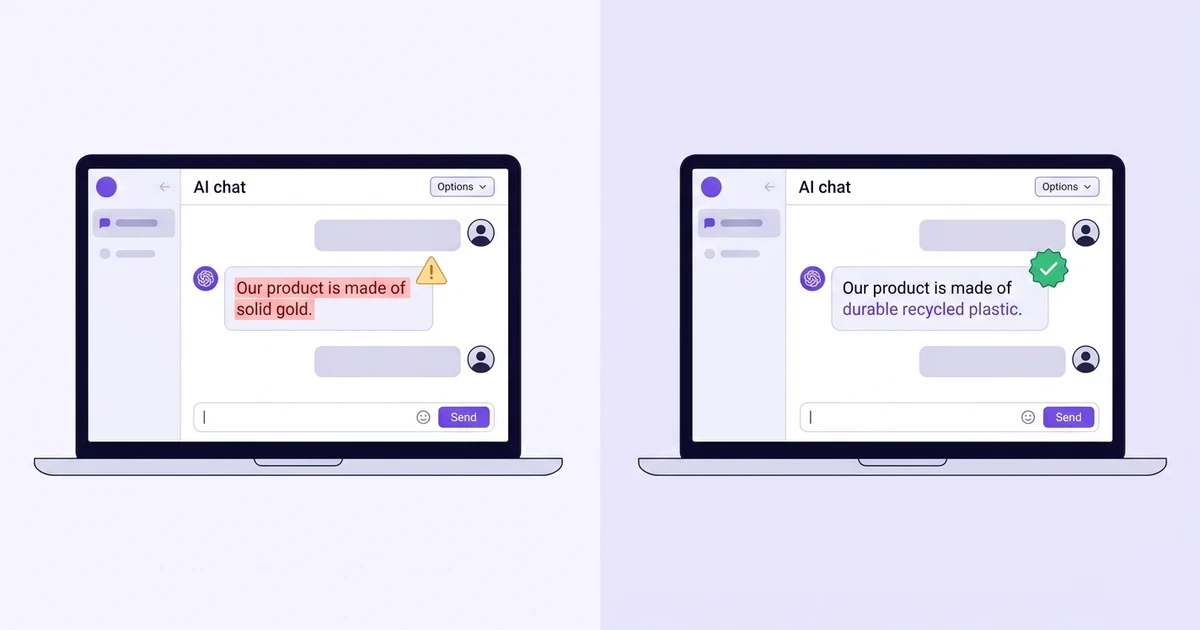
- You cannot edit AI engine outputs directly. You fix the web sources they trust and wait for engines to re-index or retrain.
- Perplexity uses real-time web search, so source updates surface faster than corrections in ChatGPT or Gemini.
- Your website, Wikipedia, and major press coverage are the three highest-trust sources to update first.
- Publishing clear, declarative sentences gives AI engines extractable facts about your brand.
- Re-run your original prompts after four to six weeks to confirm corrections actually landed.
Why does ChatGPT or Perplexity have wrong information about my brand?
AI engines pull brand facts from training data and, in some cases, live web results. When those sources contain outdated or incorrect information, the engine repeats the error.
Training data has a cutoff date, so product pivots, rebrands, or pricing changes made after that cutoff simply do not exist in the model's memory. Adobe Analytics found that traffic to US retail sites from generative AI sources grew 1,200% between July 2024 and February 2025, a sign that more buyers now research through AI engines, which makes what those engines say about your brand matter.
Perplexity AI operates differently. As documented on Perplexity's own website, Perplexity performs real-time web searches rather than relying solely on a fixed training set.
This means Perplexity's answers are only as current as the pages it indexes at the moment you ask. If your website or press coverage still carries old information, Perplexity surfaces that old information even today.
Engines can also state things that no source contains. OpenAI and Georgia Tech researchers argue this happens because training and evaluation reward guessing over admitting uncertainty (Kalai et al., 2025).
ChatGPT, powered by OpenAI's GPT-4o model, and Google Gemini both blend training data with optional real-time retrieval. OpenAI has publicly noted that GPT-4o's knowledge updates periodically.
The practical implication: corrections you make today may not surface in ChatGPT answers for weeks or months.
How do I find exactly what AI engines are saying about my brand?
Run the same prompts across all three engines and compare outputs verbatim. Use at least five prompts that mirror how a buyer researches your category: "What is [your brand]?", "What does [your brand] do?", "Is [your brand] good for [use case]?", "How does [your brand] compare to [competitor]?", and "What does [your brand] cost?"
Run each prompt in ChatGPT, Gemini, and Perplexity on the same day. Log outputs word for word.
AI engines give different answers to the same prompt, and errors are often engine-specific. A pricing error in ChatGPT may not appear in Perplexity if Perplexity found your updated pricing page on a recent crawl.
This manual audit works once but breaks down as a routine. Perplexity, ChatGPT, and Gemini can each give different answers on different days as they update.
See our guide on what AI brand visibility is for context on why these differences matter.
Which sources do AI engines trust most for brand facts?
The sources AI engines trust most appear consistently across the web with clear, factual statements. Based on publicly documented information about how large language models are trained and how Perplexity's real-time retrieval works, the highest-trust sources rank like this:
| Source | Why AI engines trust it | Speed of correction |
|---|---|---|
| Your own website | First-party, high relevance signal | Perplexity: days. ChatGPT/Gemini: weeks |
| Wikipedia | Heavily represented in LLM training datasets | Weeks (after editorial review) |
| Major press (TechCrunch, Product Hunt) | High-authority domains, widely indexed | Perplexity: near-immediate. Others: next update cycle |
| Crunchbase | Standard business fact database | Variable |
| G2, Capterra | Product category pages, heavily crawled | Perplexity: near-immediate |
Wikipedia is particularly important for ChatGPT and Gemini. It is one of the most heavily represented sources in LLM training datasets, as documented in EleutherAI's research on "The Pile" dataset.
If your Wikipedia page carries wrong facts, those facts very likely live inside the model.
How do I update what AI engines say about my brand?
- List every wrong claim and which engine said it. Write down each incorrect fact, the engine that stated it, and the exact prompt that triggered it. This becomes your correction checklist.
- Update your own website with declarative sentences. Use plain factual sentences: "Lead Rescue is a brand visibility tracking tool for indie SaaS founders." AI engines extract definition-style sentences heavily. Marketing copy is not extractable. Specific factual claims are.
- Fix Wikipedia if you have a page. Wikipedia accepts factual corrections backed by reliable citations. Add press coverage or official sources as references. Unsourced edits get reverted quickly.
- Issue press coverage for major changes. A rebrand or product pivot needs external confirmation, not just your own site. One article in a recognised publication carries more weight than ten self-published updates.
- Update every third-party profile. Crunchbase, G2, Capterra, LinkedIn company page, and Product Hunt all get indexed heavily. Keep your description, pricing tier, and category consistent across all of them.
- Publish a dated announcement post. A blog post gives AI engines a timestamped source that signals recency. Perplexity weights recency in its retrieval. A post dated this week outranks a page dated two years ago for the same claim.
How long does it take for AI corrections to show up?
Speed depends on the engine. Perplexity works fastest because it searches the live web.
If you update your website today and Perplexity recrawls it within a few days, corrected information can surface in Perplexity answers within a week. Google AI Overviews can also reflect page updates within days for frequently crawled sites.
ChatGPT is slower. OpenAI has publicly acknowledged that GPT-4o's knowledge updates periodically but has not published a specific schedule.
A realistic estimate is four to twelve weeks, and only if the corrected information appears consistently across multiple trusted sources. The same mechanism that causes wrong facts causes competitor bias: if more sources mention a competitor than you, the engine defaults to recommending them.
How do I know if my corrections actually worked?
Re-run your original prompts across ChatGPT, Gemini, and Perplexity four to six weeks after making source updates. Compare outputs to your baseline audit.
Check whether the specific wrong facts have disappeared and whether corrected facts now appear in their place.
This is the step most brands skip. Without re-running the prompts, you are updating sources and assuming the fix landed.
Running the prompts confirms it. If corrections have not surfaced in ChatGPT or Gemini after six weeks, the most likely cause is conflicting sources.
One updated page will not override ten older pages that still carry the wrong claim. See our guide on how to write content Perplexity cites for structure patterns that help corrections land faster.