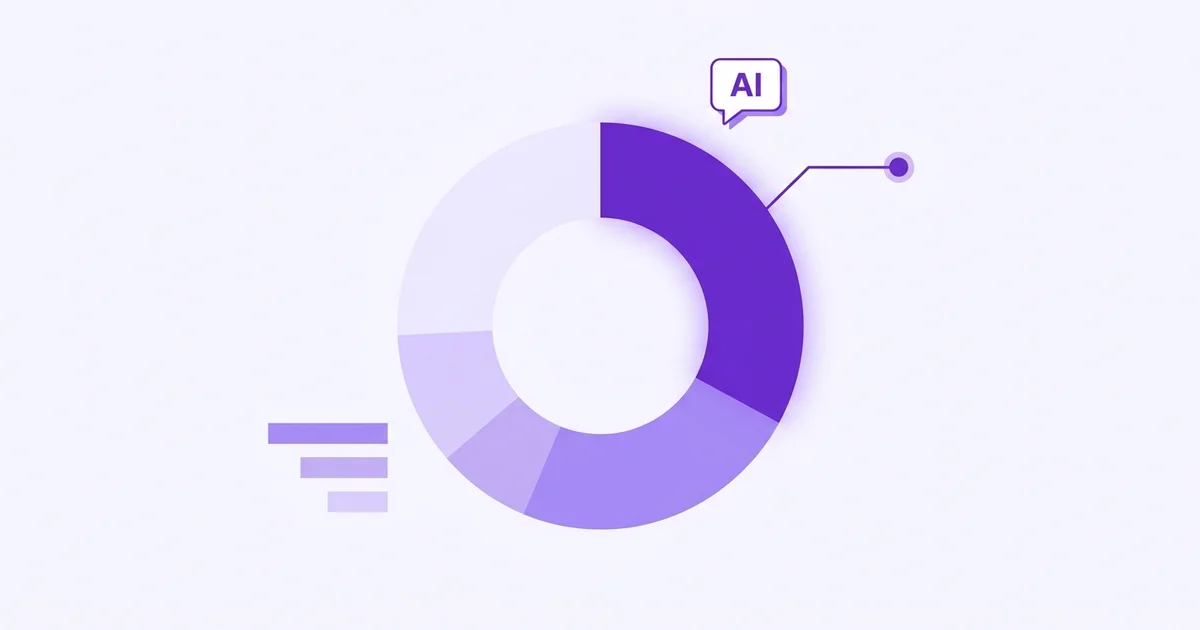
- AI share of voice measures the percentage of brand mentions your brand earns out of all brand mentions across your tracked prompts.
- It only means something against a fixed competitor set. Change the competitors, change the number.
- Direction matters more than the absolute figure. Rising share of voice over 8-12 weeks signals your content work is landing.
- AI share of voice is separate from brand coverage. You can have 60% coverage but 15% share of voice if competitors appear on every prompt too.
What is share of voice in AI search?
Share of voice in AI search is the percentage of all brand mentions your brand receives across a fixed set of tracked prompts, measured against a defined group of competitors. It answers the question: of all the times AI engines named a brand in your category this week, how many of those mentions were yours?
A 2023 Princeton study on generative engine optimisation confirmed that brand visibility in AI answers varies significantly by source and query type (Aggarwal et al., Princeton, 2023), making a relative metric like share of voice more meaningful than raw mention counts alone.
Share of voice is a relative metric, meaning it tells you your position compared to others rather than an absolute score. If you track 20 prompts and your brand appears in 8 answers, your brand coverage is 40%.
But if competitors appear in those same 20 prompts a combined 32 times and your brand appears 8 times, your share of voice is 8 out of 40 total mentions: 20%.
Coverage tells you how often you appear. Share of voice tells you whether you are winning or losing ground to the brands you actually compete with.
Both numbers matter, and they often tell different stories.
How is AI share of voice different from traditional share of voice?
Traditional share of voice, used in paid advertising and social media, measures your brand's ad spend or content volume as a proportion of the total spend or volume in a category. AI share of voice measures something different and harder to buy: how often an AI engine names your brand versus competitors when answering buyer questions.
You cannot buy AI share of voice directly the way you can buy ad impressions.
Traditional share of voice is a spend metric. AI share of voice is an authority and structure metric.
Brands with higher AI share of voice tend to appear across more trusted third-party sources, have cleaner page structure, and maintain more consistent brand descriptions, not necessarily the biggest marketing budgets. That Princeton finding is exactly why: the engine rewards credibility signals, not ad budget.
| Traditional SoV | AI Search SoV | |
|---|---|---|
| What it measures | Ad spend or content volume vs competitors | Brand mentions in AI answers vs competitors |
| How to increase it | Spend more, publish more | Better page structure, more trusted citations |
| Can you buy it? | Yes, directly | No direct purchase path |
| Speed of change | Immediate (spend more tonight) | Weeks (content and source work) |
| What a win looks like | Larger share of ad impressions | Your brand named more often than competitors |
How do you calculate your AI share of voice?
To calculate AI share of voice, count all brand mentions across your tracked prompts for a given period, across all engines you track, then divide your brand's mentions by the total and multiply by 100. The key is fixing both variables before you start: the prompt set must stay identical each period, and the competitor set must stay the same too.
Changing either one makes the numbers incomparable across time.
- Fix your prompt set. Choose 10-20 buyer-intent prompts and use the exact same wording every time you measure. Paraphrasing changes which brands get named.
- Fix your competitor set. Choose 3-5 brands you actually lose deals to. Include them in every scan, even when they are not appearing, so the denominator stays consistent.
- Run scans across all three engines. Measure ChatGPT, Gemini, and Perplexity separately, then combine for an overall figure or track them independently. They diverge enough that the overall number can mask important engine-specific gaps.
- Count every brand mention. If a prompt returns three brand names and your brand is one of them, that counts as one mention for your brand and three total mentions in the denominator. Count all brand names in every answer, not just the first one listed.
- Divide and track over time. Your share = (your mentions / total mentions) x 100. Record it weekly or fortnightly and watch the direction, not just the number.
Which prompts should you include in your share of voice measurement?
Include only buyer-intent prompts: questions a prospect would ask when actively looking for a product like yours. These are the prompts where being mentioned translates into a potential customer.
Awareness-stage prompts ("what is brand monitoring") and informational queries ("how does AI work") inflate your prompt set without generating commercially meaningful data. Focus on the prompts where being named leads somewhere.
Good prompt types for SoV measurement: "best [category] tool for [use case]", "[your category] software for [specific buyer type]", "how to [solve the problem your product solves]", "[your category] vs [competitor category]". Bad prompt types: broad category definitions, educational how-tos with no purchase intent, prompts where your category is only tangentially relevant.
Rand Fishkin of SparkToro, who has tracked AI answer patterns across thousands of queries, notes that the prompts where brands appear most consistently are the high-intent, specific ones, not the broad awareness queries. Measure where purchase decisions happen, not where curiosity happens.
What is a good share of voice percentage?
There is no universal target, and chasing a specific number before understanding your competitive set leads to wrong conclusions. What matters is direction: your share of voice should trend upward quarter over quarter, and it should stay ahead of your closest direct competitor.
In tightly defined niches with 3-5 real competitors, established brands commonly reach 30-50% AI share of voice over 6-12 months of consistent content and citation work.
Starting from zero is normal. A new brand with no prior AI visibility might see 5-10% share of voice in the first weeks of tracking, not because they are failing, but because the models have not yet seen enough repeated, trusted signals.
Moving from 5% to 20% over 10 weeks is a strong result. Moving from 40% to 55% is harder and takes longer.
Pew Research found 34% of US adults had used ChatGPT by 2025, which means the size of the audience for these AI answers is large enough that even a modest share of voice improvement translates to real buyer exposure.
How does share of voice relate to the other AI visibility metrics?
Share of voice is the most strategic of the five core AI visibility metrics because it is the only one that measures your position relative to competitors rather than in isolation. Brand coverage tells you how often you appear.
Share of voice tells you whether you are winning or losing. Use brand coverage as a leading indicator and share of voice as the verdict on whether your content work is actually moving you ahead.
The five metrics together form a complete picture. Brand coverage shows reach.
Domain citations show whether engines trust your pages as a source. Average position shows where in an answer you appear.
Sentiment shows how you are being described. Share of voice shows competitive standing.
A rising share of voice alongside flat coverage usually means competitors are losing ground. Rising coverage with flat share of voice means the whole category is gaining attention but you are not pulling ahead.
For a full breakdown of all five metrics and how to track them, read our guide on how to track brand visibility in AI search.