- AI treats third-party coverage, review sites, forums, and media, as proof, and brand-owned pages as marketing, so third parties get cited far more often.
- In our own tracking of 165 AI answers about a consumer brand, it was named 93% of the time but its own website was cited only twice.
- Which specific source wins depends on the engine: ChatGPT leaned on editorial sites, while Gemini and Perplexity leaned on YouTube and Reddit.
- Structured, cited, quotable content is up to 40% more likely to be pulled into AI answers than unoptimized pages (Aggarwal et al., Princeton, 2023).
What does it mean when AI cites a source?
A citation is when an AI engine names the exact page it pulled information from to back up a claim in its answer.
It is different from a mention, which is just your brand's name appearing in the text with no source attached. Citations are what get you found by someone reading the answer; mentions alone rarely drive a click.
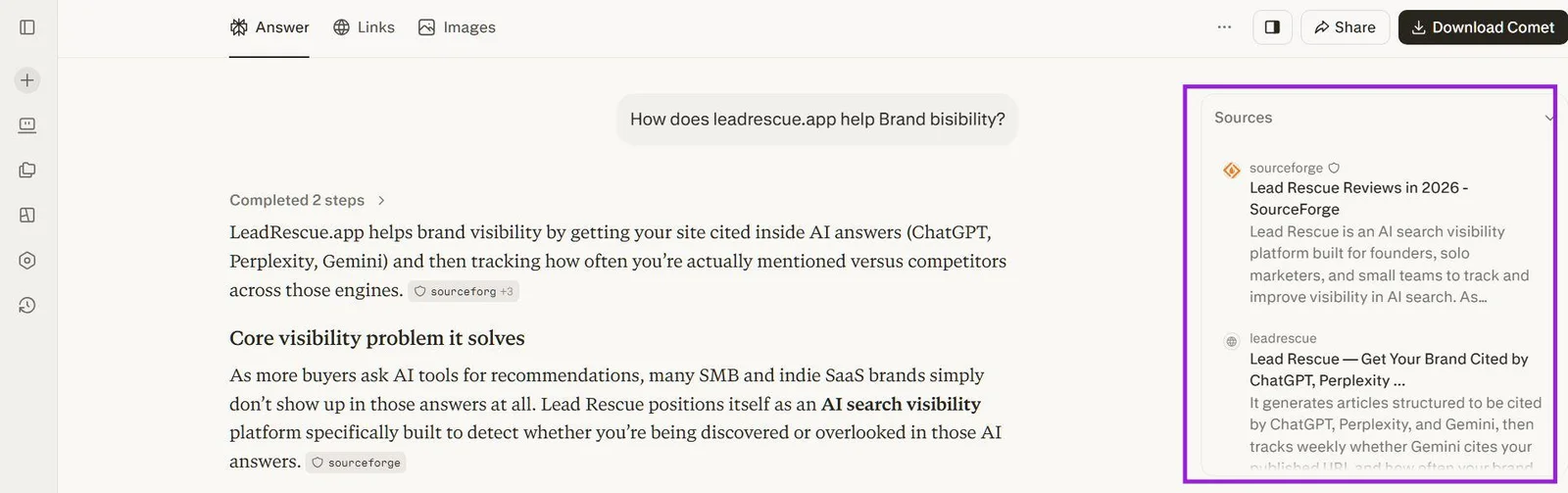
Note: a mention is your brand's name showing up in an AI answer. A citation is the AI linking to a specific page as proof. You can have a lot of mentions and almost no citations, and that gap is the whole subject of this guide.
What counts as a citation in AI answers?
A citation is a specific URL an AI engine references as the source behind a fact, price, or recommendation in its answer.
For example: if ChatGPT writes "many solo marketers use Lead Rescue for brand visibility tracking" with no link attached, that is a mention. If the same sentence links back to the exact page ChatGPT pulled that claim from, whether that page is leadrescue.app or a review site that said it first, that is a citation.
ChatGPT, Perplexity, and Google AI Overviews each show citations differently: Perplexity lists numbered footnotes inline, ChatGPT often adds a short source list below the answer, and Google AI Overviews shows expandable source cards. What counts is the same across all three: the AI is pointing at a specific page, not just recalling your brand name from training data.
What is the difference between first-party and third-party citations?
A first-party citation is when an AI engine links to a page on your own domain. A third-party citation is when it links to someone else's page, a review site, a forum thread, or a news article, to back up a claim about your brand.
Third-party citations dominate. In our tracking, a well-known brand's own domain was cited in under 2% of the answers where the brand was named (leadrescue.app analysis, 2026).
| Citation type | Example source | What it signals to AI |
|---|---|---|
| First-party | yourbrand.com/product-page | The brand's own claim about itself |
| Third-party editorial | Tom's Guide, industry blogs | An independent expert opinion |
| Third-party review or aggregator | G2, RunRepeat, Capterra | Aggregated user or reviewer consensus |
| Third-party community | Reddit, forums | Unfiltered real-user experience |
Can AI use my content without linking to my site?
Yes. AI engines are trained on a wide crawl of the web, and a model can recall facts about your brand, your product name, even a specific claim, without citing any URL at all.
This is why your brand can be named in an AI answer with zero citations attached: the model is drawing on what it learned in training, not looking at a live source in that moment, based on the publicly documented behavior of these systems as of 2026.
The exception is if you block AI crawlers outright, which can remove you from live citations entirely. We cover that trade-off in whether blocking AI crawlers hurts your brand visibility.
How can I tell if AI is citing my website or someone else's?
You can tell if AI is citing your website or someone else's by using tools built to track AI citations instead of checking by hand.
Running your own prompts through ChatGPT, Perplexity, and Google AI Overviews and reading the source list works too. None of these platforms report this in Google Search Console or any free analytics tool by default.

How do I check sources in ChatGPT, Perplexity, and Google AI Overviews manually?
Type a buyer-intent question into each engine separately, the kind a customer would ask right before choosing a product like yours, and look at the sources it shows.
Perplexity displays numbered citations inline, and ChatGPT shows a short source list, though not on every answer. Google AI Overviews shows expandable source cards under the generated text.
Doing this by hand for even 10 prompts across 3 engines means reading 30 separate answers every time you check, which does not scale past a handful of one-off checks.
For anything more frequent than that, an automated AI visibility tracking setup reads the answers for you and logs the result.
How can I verify whether AI is citing my site or a competitor's?
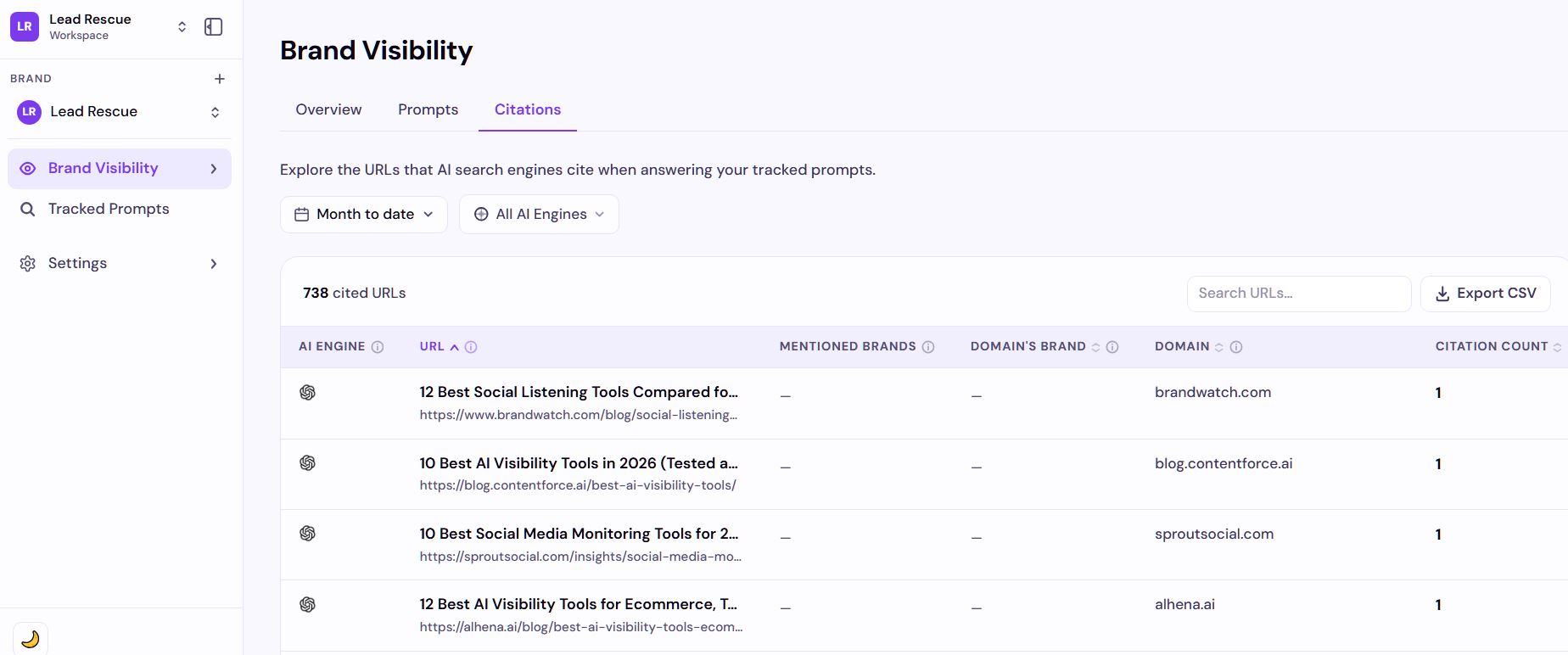
Compare the domain in each citation against your own domain and your named competitors' domains. In Lead Rescue's Citations report, every source an engine cited is logged with the domain, the AI engine, and which brands were mentioned in that answer, so you can see in one table whether it was your page, a competitor's page, or a third party that got the citation.
How do I find out which pages on my site get cited most?
Filter your citation data down to rows where the domain matches your own site, then group by URL. Most brands find the answer is a very short list, often a single comparison page or a well-cited blog post doing most of the work, with the homepage and product pages rarely appearing because they read as marketing rather than evidence.
What types of third-party sources are being cited instead of you?
AI engines mostly cite three types of third-party sources: editorial or review sites, aggregators and comparison platforms, and community discussion like Reddit or forums, in that rough order of frequency across the answers we have tracked.
Why do AI tools cite review sites and aggregators?
It is not only that AI can lift their text easily. It is that review sites and aggregators carry independent trust, which shapes how both buyers and the model perceive your brand.
When someone asks "which is the best tool for X," a G2 page with hundreds of verified reviews, or a Capterra comparison with side-by-side ratings, answers that question with evidence the AI can extract and cite. Your product page, however well-written, only makes claims about itself.
These pages are also built for extraction. In our own 11-day tracking of 165 AI answers about a consumer brand, RunRepeat alone was cited 129 times, the second-highest source behind YouTube, because its pages already answer "which is best for X" in a format AI can lift almost verbatim (leadrescue.app analysis, 2026).
The fix is not more marketing copy. It is earning a place on the third-party sites AI already trusts, which we walk through in how to get your SaaS listed on AI comparison sites.
Why does AI use Reddit, forums, or user-generated content?
Reddit and forum threads read as unfiltered opinion from real users rather than marketing copy, which AI engines treat as a trust signal. Reddit was cited 52 times across the same 165-answer dataset, and Perplexity in particular leans on it heavily: it was the second most-cited source on that engine specifically (leadrescue.app analysis, 2026).
A forum thread with genuine back-and-forth debate is harder to fake than a single five-star review, and AI models appear to weight that. If Reddit dominates your category, our guide on getting your brand mentioned on Reddit so AI engines cite it covers the honest way to do it.
Do different AI platforms cite different types of sources?
Yes, each engine has its own sourcing habits. In our tracking, ChatGPT cited YouTube zero times and Reddit only once across 254 citations, leaning instead on editorial sites like Tom's Guide.
Gemini and Perplexity did the opposite, citing YouTube more than any other single source. Read the full breakdown in our analysis of which sources each AI engine cites most.
Why is AI citing other websites instead of mine?
AI cites other websites instead of yours because those pages show up consistently across multiple independent sources, while a single brand page is, by definition, one source making a claim about itself, which is weaker evidence for a generative answer to lean on.
Why does AI prefer sources that appear in multiple places?
When the same fact, price, or recommendation appears across several independent pages, an AI engine treats that repetition as a signal the claim is reliable. A brand making a claim about itself on one page is one data point.
The same claim echoed across a review site, a forum thread, and a comparison article is three, and three independent data points beat one every time a model has to decide what to trust.
Why do third-party sources seem more trustworthy than brand sites?
A brand telling you its own product is the best has an obvious conflict of interest. A stranger on Reddit or a review site with no stake in the outcome does not, at least not one the model can detect.
This is not about your content being lower quality. It is a structural bias built into how these systems weigh evidence: independent claims outrank self-reported ones.
Why can my site rank in search but still not be cited in AI answers?
Ranking in Google and getting cited by an AI engine are different scoring systems entirely. Google's ranking weighs backlinks, technical SEO, and relevance to a keyword.
AI citation weighs whether a passage can be lifted cleanly and whether the same fact appears elsewhere too. A page can rank first for its target keyword and still never get quoted, because ranking answers "is this page relevant," not "can I safely repeat this claim."
We break down the two scoring systems in GEO vs SEO: what's actually different.
How do AI systems decide which sources to use?
AI systems favor sources that are structured for easy extraction, mentioned consistently across the web, and independently corroborated, weighing these signals differently depending on which engine is generating the answer.
What signals make a source more likely to be cited?
Content structured with a direct answer up front, clear headings, and comparison tables is easier for a model to extract and quote with confidence than unstructured, unoptimized pages. This practice of structuring pages for AI answers is called generative engine optimization (GEO).
Freshness, a clear date, and named specifics like numbers and sourced claims also help a passage get lifted cleanly.
Does being mentioned across the web affect AI citations?
Yes. A brand that shows up consistently across many independent pages, review sites, comparison articles, forum threads, gives an AI engine more places to pull corroborating evidence from. This breadth of coverage is what share of voice in AI search measures.
In a separate 50-prompt study we ran across ChatGPT, Perplexity, and Gemini, the most consistently mentioned brand appeared in 62% of all 50 topics tested, a level of coverage most brands do not have (leadrescue.app analysis, 2026).
Does content structure affect whether AI can use a source?
Yes, a page with a clean answer-first paragraph, a comparison table, and clear headings is far easier for a model to extract and quote than a page that buries its point three paragraphs into a marketing narrative.
Structure does not change what is true about your product. It changes how easily a model can lift a clean, quotable sentence out of the page.
Does Google AI Overviews choose sources differently from ChatGPT or Perplexity?
Yes, based on publicly documented behavior as of 2026, the major engines pull from noticeably different pools of sources. In our own tracking, one engine cast the widest net at 928 citations across 185 distinct domains.
Another repeated a narrower set of sources most often at 474 citations across just 49 domains, and a third leaned heavily on editorial sites over video or forums. Optimizing for one engine does not guarantee coverage on another, so getting cited in Google AI Overviews takes different work than winning ChatGPT.

How can I improve my presence across sources AI already trusts?
Find the specific third-party sites AI engines are already citing in your category, then earn genuine coverage on those exact sites, since getting listed on a source AI has never cited for your topic does little compared to appearing on one it already trusts.
Which third-party sources matter most in my category?
Run your own tracked prompts through each engine and log every domain that gets cited, then rank them by frequency. The pattern is rarely evenly spread.
In our sneaker-category tracking, three sources, YouTube, RunRepeat, and Reddit, accounted for most of all third-party citations, while dozens of other sites appeared once or twice. Chasing the long tail wastes effort; the top handful of sources in your category is where it counts most.
How can I influence how my brand appears on those sources?
- Get reviewed, not just listed. A detailed, specific review on a site AI already cites in your category is worth more than a generic directory listing on a site it has never cited.
- Participate genuinely in relevant threads. Reddit and forum citations come from real discussion, not planted posts. Answering real questions in communities where your buyers already ask them is the honest version of this.
- Pitch comparison and roundup articles. "Best X for Y" and "X vs Y" pages are the exact format AI engines quote most easily. Being included in one on a site AI already trusts compounds fast.
- Track it, do not guess. Re-run your prompts after each push and check whether the specific source you targeted actually shows up in a citation. If it does not within a few weeks, the coverage did not land the way you hoped.
What should I fix on my own site to increase AI citations?
Rewrite your highest-intent pages to open with a direct, quotable answer instead of marketing language, add a comparison table where relevant, and state the specific facts a buyer would ask about plainly instead of implying them.
What kind of content is most likely to be cited by AI?
Pages that answer one specific, buyer-intent question directly in the first 40 to 60 words get cited far more often than long marketing narratives that build up to a point. According to research from Princeton and Georgia Tech, 73% of AI citations come from the first 30% of an article, meaning most of a page's citation value is decided in its opening section, not its conclusion.
How can I structure content so AI can easily extract it?
See how to write content that gets cited by Perplexity for the full playbook. The short version:
- Open with the direct answer. State the actual answer in the first sentence, in 40 to 60 words total, before any context or backstory.
- Use question-shaped headings. Phrase H2s and H3s as the real questions a buyer would type, not vague topic labels like "Overview" or "Features." Pairing them with FAQ schema makes them easier still for engines to quote.
- Add a comparison table wherever you are comparing options. Tables get extracted cleanly; paragraphs describing multiple options do not.
- Cite your own sources. A page that links out to credible external data reads as more trustworthy to a model than an unsupported claim.
Which pages should I update first?
Start with the pages closest to a buying decision: comparison pages, "best X for Y" pages, and pricing or feature pages, since those match the buyer-intent prompts people are actually typing into AI search.
Quick win: update pages that already rank reasonably well in Google before writing anything new. A page with some existing authority is far more likely to earn a citation once restructured than a brand-new page starting from zero.
How do I know if my AI citation strategy is working?
The only real signal is whether your own domain starts showing up as a cited source in AI answers more often over time, which means tracking citations directly, since neither Google Search Console nor Google Analytics report on them.
You can start by hand for free. Our guide on measuring your GEO progress without paid tools shows the manual method, and whether AI citations actually drive traffic covers why the number is worth chasing.
What should I measure to know if AI is citing my site more?
Track two numbers over time: how often your brand is named (mention rate) and how often your own domain specifically gets cited as a source (domain coverage). These move independently.
A brand can be named in 97% of answers while its own domain is cited in 0% of them, which is a different problem than low mention rate and needs a different fix.

How can I measure if AI answers are citing my brand versus third-party sites?
For every tracked prompt, log the full list of domains cited in the answer and flag which ones are yours versus everyone else's. Over enough prompts and days, this produces a ratio: what share of all citations for your topic are your own domain versus third parties.
In most categories we have tracked, that ratio sits well under 5% for brand-owned domains, even for brands named frequently (leadrescue.app analysis, 2026).
How do I compare my AI citation performance against competitors?
Track the same prompts for your competitors' domains alongside your own, using the exact same date range and engines, then compare citation counts side by side. Our guide on tracking which competitors AI engines recommend covers the setup.
This tells you not just whether you are being cited, but whether a specific competitor is winning the citation for a prompt you are losing. If a rival keeps beating you, why ChatGPT recommends your competitor explains the usual cause.
How long does it take for new or updated content to get cited by AI?
There is no fixed timeline, since it depends on how quickly the engine's index refreshes and how much competing content already exists for the same query.
In practice, expect weeks rather than days for a newly restructured page to start appearing in citations. Because AI citations change from day to day, judge the trend over a few weeks rather than any single check.
Lead Rescue's Citation report shows exactly which domain each engine cited for every tracked prompt, yours, a competitor's, or a third party's, so you always know where to focus next. See where AI engines get your brand →