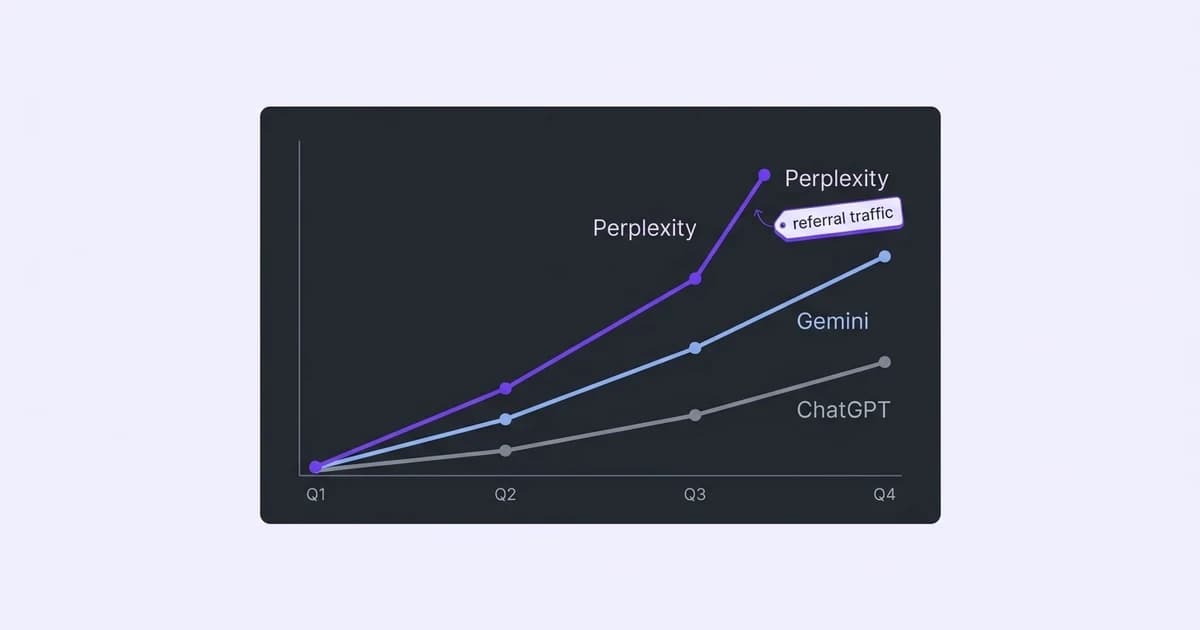
- Perplexity citations drive real, trackable referral traffic visible in Google Analytics under "perplexity.ai."
- ChatGPT answers rarely include clickable links, so they build brand awareness more than direct traffic.
- Google AI Overviews reduce click-through rates for organic results that appear below them, per multiple published studies from 2024.
- The traffic volumes from AI citations are currently smaller than traditional search but growing as AI adoption increases.
- Brand awareness from AI citations still has business value even when it does not show as a referral visit.
What counts as an AI search citation?
An AI search citation is a named source that an AI engine references when generating an answer. Citations come in two forms.
The first is a clickable link, like the numbered references (1), (2) Perplexity shows beside claims in its answers. The second is a non-linked mention, where an AI engine names a source, brand, or publication in the text without a hyperlink the user can click.
Clickable citations send direct referral traffic. Non-linked citations build awareness without a measurable visit.
Understanding which type each engine produces is important because it determines whether you will ever see AI citations in your analytics at all. As of 2025, based on publicly observable product behaviour, Perplexity and Google AI Overviews produce clickable citations.
ChatGPT's standard interface produces non-linked mentions in most cases.
Does Perplexity send traffic to cited websites?
Yes. Perplexity consistently produces numbered clickable citations beside claims in its answers.
Any user who wants to verify a claim can click those numbered links and land on the cited page. This traffic shows up in Google Analytics or similar tools as referral traffic from "perplexity.ai."
The volume is modest today compared to organic search but it is measurable. A site with one cited article can expect a trickle of referral visits per day, scaling with how often Perplexity cites that article across different prompts.
The more buyer-intent prompts your content answers, the more citation opportunities exist. Perplexity was handling 100 million search queries per week as of October 2024, per TechCrunch, a figure that has grown substantially since.
Getting your content structured to be cited by Perplexity is therefore one of the most actionable traffic levers available right now.
Do ChatGPT answers drive traffic to websites?
Rarely, in the direct referral sense. ChatGPT's standard interface does not include clickable hyperlinks in most answers.
When ChatGPT mentions your brand or cites your content, there is no link for the user to click. They would need to open a browser separately and search for you.
This does not mean ChatGPT citations have zero value. A brand mentioned by name in a ChatGPT answer gets awareness exposure.
If the mention is positive and contextually relevant, the user may search your brand name. That conversion appears in your analytics as direct or branded organic traffic, not as a ChatGPT referral.
The connection is invisible but real. ChatGPT Plus with the Browsing feature enabled can include citations and links, as documented by OpenAI.
But the majority of ChatGPT users access the free tier, where linked citations are not the norm.
How do Google AI Overviews affect website traffic?
Google AI Overviews, powered by Gemini as Google confirmed at Google I/O in May 2024, appear at the top of search results pages for certain queries and show a synthesised answer before any traditional organic results.
Research published by Seer Interactive in 2024 found that click-through rates for top organic positions dropped when AI Overviews appeared on the same results page. A separate study from Ahrefs in 2024 found similar patterns for informational queries, where users found sufficient answers in the AI Overview without clicking through.
The cited sources inside an AI Overview do get clickable links. Being one of the sources Google's AI Overview cites is therefore more valuable than simply ranking below the AI Overview, because cited sources appear within the Overview itself.
BrightEdge data published in 2025 found that one year after AI Overviews launched, Google Search usage actually increased by 49%, suggesting AI Overviews draw more people into Google Search rather than cannibalising it.
Is AI citation traffic worth pursuing?
The traffic volumes from AI citations are smaller than traditional organic search today, but the trend is moving fast. Google AI Overviews rolled out to all US users in May 2024, according to Google's official announcement at Google I/O 2024.
Perplexity's query volume has grown to an estimated 1.2 to 1.5 billion queries per month by mid-2026, per industry research. Whether traffic is "worth it" depends on which metric you are optimising for.
If you are counting referral sessions, Perplexity citations are worth pursuing now. If you are counting ChatGPT exposure as brand awareness, it is worth pursuing even without the referral data to prove it.
And if you are concerned about Google AI Overviews reducing your existing organic traffic, not pursuing AI visibility is the riskier choice. The strongest argument for tracking AI citations now is that the habit is cheap to build early and expensive to retrofit later.
Here is how the three compare at a glance:
| Engine | Clickable citations? | What you will see | Where to measure it |
|---|---|---|---|
| Perplexity | Yes, numbered links beside claims | Referral visits from "perplexity.ai" | Google Analytics referral report |
| ChatGPT | Rarely, in the standard interface | Awareness, then branded searches | Branded search volume in Search Console |
| Google AI Overviews | Yes, for the cited sources | Fewer clicks on organic results below the Overview | Impressions and click-through rate in Search Console |
How do you measure traffic from AI engine citations?
For Perplexity, check your Google Analytics referral report for traffic from "perplexity.ai." This is direct and reliable.
Filter by that referral source and track it month over month. For Google AI Overviews, Google Search Console is the primary tool.
Monitor overall impression and click-through rate trends for specific queries. If impressions for a query rise while clicks stay flat or fall, an AI Overview has likely appeared and users are finding their answer without clicking through.
This is the pattern documented in Seer Interactive's 2024 research on AI Overview click-through rate impact.
For ChatGPT, there is no direct referral signal today. Track branded search volume in Google Search Console as an indirect indicator.
If branded searches rise after a period where ChatGPT starts mentioning your brand more frequently, that correlation is meaningful even without a direct attribution path. Our guide on how to track brand visibility in AI search covers the full measurement setup across all three engines.